





19%
Teams with AI fully embedded in workflows
54%
Still in experiment or pilot mode
25-40%
Faster campaign cycles with AI automation
3-7h
Hours saved per week per marketer
TL;DR
- AI automation is moving from isolated task replacement to end-to-end workflow redesign. Teams gaining 3x velocity rebuild processes around AI, not just add AI to existing ones.
- Only 19% of marketing teams have AI fully integrated into daily workflows. The 54% still in pilot mode represent the single biggest competitive opportunity in B2B marketing today.
- The three highest-leverage AI automation applications in B2B: content distribution across channels (saves 3-5 hours/week), lead enrichment and scoring (15-25% connect rate lift), and campaign analysis (reporting cycles shrink from hours to minutes).
- 75% of marketers rely on consumer-grade AI apps instead of integrated enterprise solutions. The teams embedding AI into CRM, MAP, and analytics get compound returns; isolated experiments get isolated results.
The State of AI Automation in B2B Marketing: 2026
The conversation around AI in marketing has shifted dramatically in the past 18 months. In 2024, the dominant question was “should we use AI?” By early 2025, it became “which AI tools should we try?” In mid-2026, the question that separates winning teams from struggling ones is: “how do we rebuild our workflows around AI instead of just layering AI on top of broken processes?”
That last question is the hard one. Adding ChatGPT to a content workflow that still requires five rounds of manual review, three platform exports, and a Slack thread to find the latest brand guidelines is not automation. Real automation happens when the workflow itself is redesigned to eliminate the handoffs, the exports, and the context rebuilds that consume 30-40% of a marketer’s week.
The data backs this up. Only 19% of marketing organizations have AI fully embedded into their daily operations. The remaining 81% are split: 54% are in experiment or pilot mode, and 27% have not started. The gap between the 19% and the 54% is the single biggest competitive opportunity in B2B marketing right now, and it widens every quarter the pilot teams delay moving from experimentation to integration.
Where AI Actually Rewires the Workflow
There are three areas where AI automation fundamentally changes how B2B marketing teams operate, not just how fast they produce output. Each represents a specific workflow redesign opportunity, not a tool replacement.

1. Content Distribution at Scale
The old way: write one piece of content, manually format it for LinkedIn, extract sections for Twitter, rewrite the angle for a newsletter, and separately brief a designer for visuals. This process consumes 60-70% of the production cycle on distribution, not creation.
The AI-automated way: one draft feeds an AI distribution workflow that generates platform-optimized versions across LinkedIn, Twitter/X, email, and blog in minutes. The AI handles formatting, length adaptation, and tone shifts. The marketer shifts from formatting to deciding which angles to test and which platforms to prioritize. Teams report saving 3-5 hours per week per person on distribution alone.
2. Lead Enrichment and Scoring
The old way: inbound leads land in the CRM. An SDR manually researches each lead — checking LinkedIn, looking up the company, verifying firmographics, searching for intent signals. This takes 10-15 minutes per lead and results in inconsistent enrichment quality depending on the SDR’s thoroughness. In practice, many leads get minimal research before outreach.
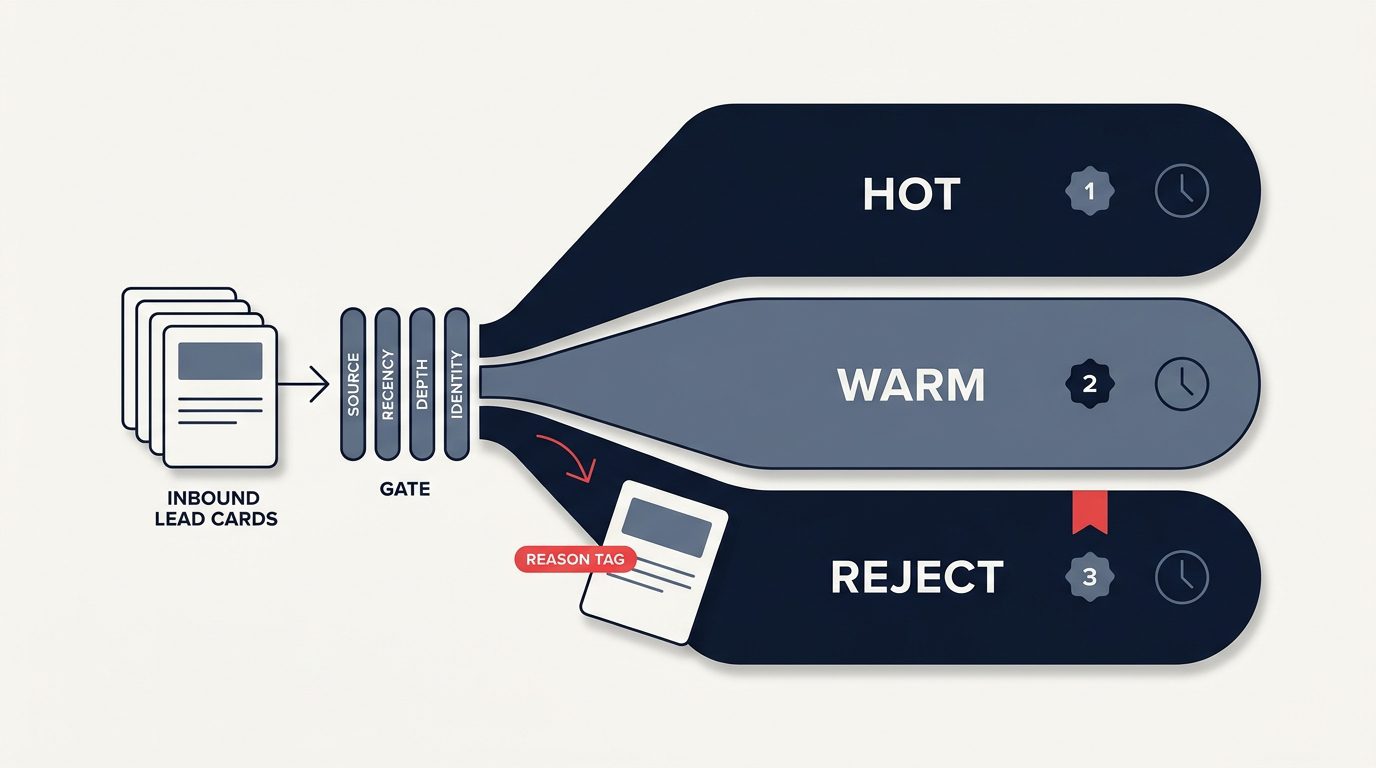
The AI-automated way: AI agents scrape company data, LinkedIn profiles, technographic signals, and intent data for every inbound lead, then score and route them based on revenue-weighted criteria. The lead arrives at the SDR with a complete profile and a suggested next action. Teams implementing this see 15-25% improvement in connect rates within 60 days, not because messaging improved but because SDRs stop reaching out to leads no longer at the company, at the wrong title, or at a company that no longer fits the ICP.
3. Campaign Analysis and Reporting
The old way: every Monday, a marketing ops person exports data from 3-5 platforms — CRM, ad platform, email tool, analytics. They spend 2-4 hours building a dashboard, writing a narrative summary, and distributing it to stakeholders. By the time the report is complete, the data is already 2-3 days stale and the recommendations are based on lagging indicators.
The AI-automated way: AI pulls data from all connected platforms in real time, produces narrative analysis with specific recommendations, surfaces anomalies and trends, and distributes a formatted report. The ops person shifts from data wrangling to strategic analysis — interpreting the AI’s findings and deciding what to do about them.
“The teams that get AI right are not the ones using it to write faster. They are the ones using it to redesign how work gets done.”
The Consumer-Grade AI Trap
Here is the uncomfortable statistic: 75% of marketers rely on consumer-grade AI apps for their daily work. They are using personal ChatGPT accounts, free-tier Gemini, and standalone AI tools that sit outside the enterprise tech stack. This creates a data governance risk, a security exposure, and — most importantly — a workflow integration gap.
The difference between personal AI usage and enterprise AI integration is the difference between using a calculator and building a financial model. Both involve math. One produces isolated answers. The other produces a system that compounds. Teams running AI as isolated experiments get isolated results. Teams embedding AI into their CRM, marketing automation platform, and analytics stack get compound returns because the AI has access to the context, data, and workflows that make its outputs relevant and actionable.
The 90-Day Automation Roadmap
Moving from pilot mode to integrated AI automation requires a structured approach:
| Phase | Action | Outcome |
|---|---|---|
| Weeks 1-2 | Audit current workflows for repetitive manual tasks consuming over 2 hours per person per week. Focus on distribution, reporting, and data entry. | Prioritized automation opportunity list |
| Weeks 3-4 | Pick one workflow to automate end to end. Content distribution is safest — mature tools, immediate ROI, low risk. | One automated workflow live and measured |
| Weeks 5-8 | Run automated alongside manual. Compare time spent, output quality, error rates, and team satisfaction. | Quantified ROI by workflow |
| Weeks 9-12 | Automate 2-3 more workflows based on learnings. Build a team playbook for evaluating, adopting, and measuring automation. | Repeatable automation playbook |
The Bottom Line
AI automation in B2B marketing is not about replacing people. It is about removing the repetitive, low-judgment work that consumes 30-40% of a marketer’s week so they can focus on strategy, creativity, and relationship building. The teams winning in 2026 are not the ones doing more with AI. They are the ones doing different work — work that AI cannot do — while AI handles the rest.
The 19% of teams that have figured this out are not smarter or better funded. They simply stopped treating AI as a tool and started treating it as workflow infrastructure. That distinction is the difference between saving 3 hours a week and 3x your team’s effective output. The other 81% are still debating which chatbot to use while the gap widens every quarter.
Building AI-powered marketing systems? Let us talk about your automation stack.