

TL;DR
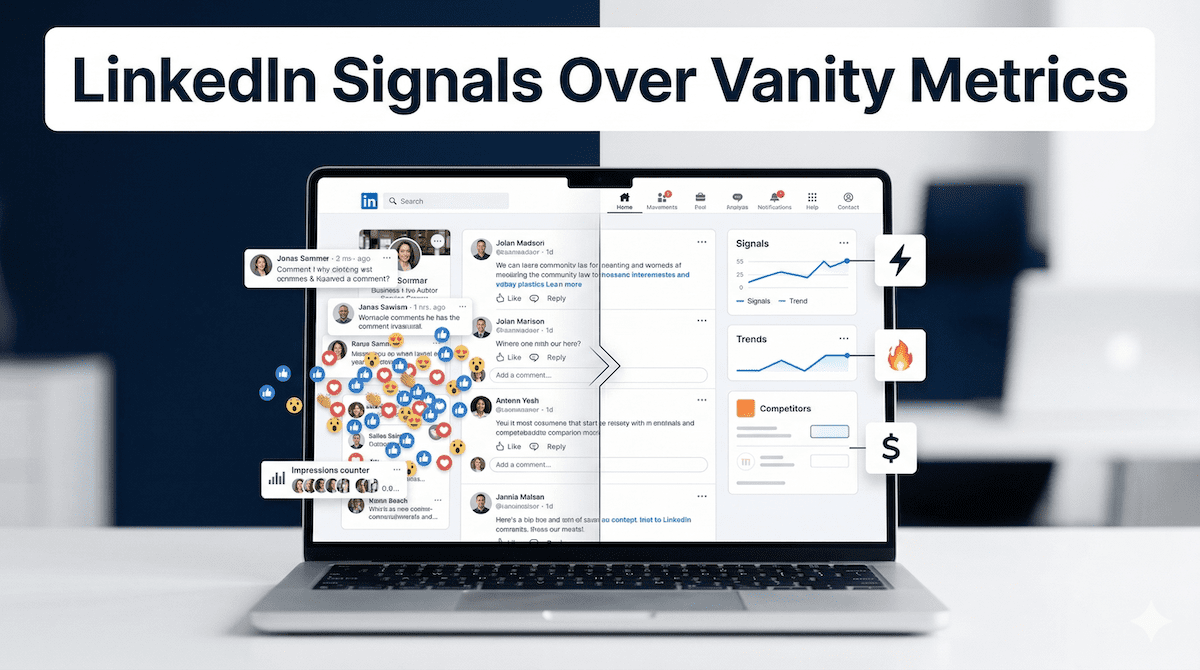
Most social teams are not short on metrics. They are short on signal. The useful question is not whether a post performed. It is whether the pattern tells you what to change next.
- Recent benchmark data still shows format and narrative choices move outcomes, especially on LinkedIn.
- The operating gap is not publishing volume. It is the inability to explain what changed and why.
- Public posts, comments, reactions, and cadence already reveal enough to improve briefs, reviews, and competitor tracking.
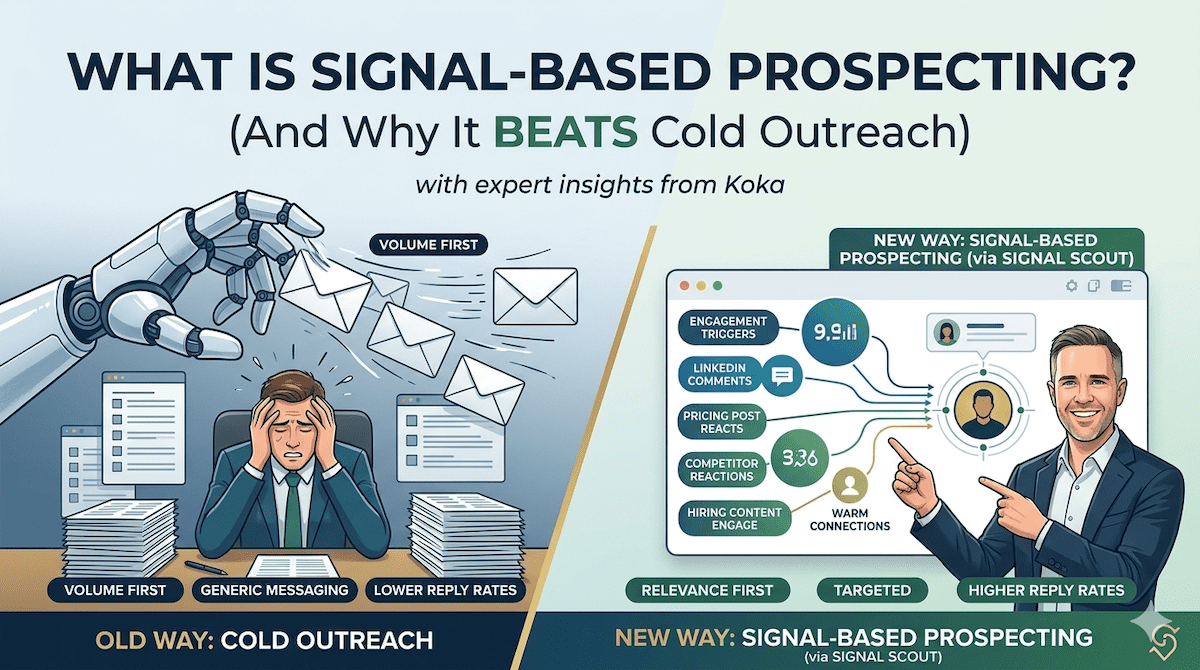
- SignalScout is strongest when it turns visible behavior into decisions instead of more dashboard clutter.
Most teams are measuring the wrong thing
A reaction count is not a strategy. A weekly screenshot of top posts is not a planning system. Most teams can report what happened after the fact, but they still cannot explain why one theme earned traction, why another stalled, or why a competitor changed its publishing rhythm.
That gap matters because the market is still moving. Socialinsider’s 2025 LinkedIn benchmark, based on one million posts from 9,000 active business pages across 2024, found engagement by impressions at 5.0%, up 30% year over year. Multi-image posts led at 6.6%, native documents hit 5.85%, video reached 5.6%, and polls drove the highest impressions. Content Marketing Institute’s 2025 B2B benchmark found that 85% of marketers still rank LinkedIn as the social platform delivering the best value, yet 45% say they lack a scalable content model and 56% struggle to attribute ROI.
That combination should change how teams think. The platform still matters. The audience is still there. The weak point is interpretation.
| Source | Recent data point | Why it matters |
|---|---|---|
| Socialinsider 2025 | LinkedIn engagement by impressions up 30% YoY | Format and timing still change outcomes |
| CMI 2025 | 85% say LinkedIn delivers the best social value | The channel remains strategically important |
| CMI 2025 | 45% lack a scalable content model | Teams are still operationally fragile |
| Sprout Social 2026 | 4 in 5 consumers expect to engage as much or more with brand content | Audience demand is not the bottleneck |
| LinkedIn + Ipsos 2025 | 94% say trust is the top B2B brand factor | Messaging quality has commercial weight |
I do not want another prettier dashboard. I want to know which signals belong in the next brief, which ones belong in the review, and which ones are just noise.
The useful signal is usually visible in public
A lot of teams act like insight lives only behind private analytics. That is lazy thinking. Posts, comments, reactions, and cadence already expose enough behavior to show what is gaining traction in the open.
Sprout Social said on January 29, 2026 that four in five consumers expect to engage with brand content the same amount or more this year. The same research said 87% of marketers want their brand on more networks, while the top thing they said would improve strategy was real-time insight into what their audience wants to consume. That is exactly where good content work is still breaking down.
The useful signal is not the spike. It is the shift.
This is where content signal analysis earns its keep. It converts visible activity into something operational. Instead of telling a team that a post “did well,” it can show that comment quality rose when the narrative shifted from tactical advice to operator POV, or that a competitor’s engagement moved after a format change, not after a volume change.
That matters for LinkedIn engagement funnels, for smarter competitor signal work, and for building a scalable content strategy that does not get rebuilt every quarter.
I care less about the viral outlier than the repeatable pattern. That is where the edge usually shows up first.

What teams should actually do with the signal
The mistake is not failing to collect enough data. The mistake is failing to decide what the data is for. LinkedIn’s 2025 trust research with Ipsos found that 94% of marketers see trust as the top factor in B2B brand success, 78% are using video, and 41% say short-form social video drives the highest ROI. Those are not trivia points. They are decision inputs.
If a team wants stronger LinkedIn planning, it should use public signals in four ways:
- Use format data to decide what deserves more testing, not to crown one format forever.
- Use comment depth and saves to judge whether attention is commercially meaningful.
- Use competitor cadence shifts to update editorial priorities before reviews become postmortems.
- Use repeated audience response to tighten messaging, not just post scheduling.
That is also why SignalScout’s positioning is strong. It is not promising magic. It is promising an explainable layer between public activity and better decisions. That is more credible, and frankly more useful, than another black-box score pretending to predict the future.

The practical win is straightforward. Better inputs create better briefs. Better briefs create better publishing decisions. Better reviews create better iteration. When that loop is tight, teams can run content more like a system and less like a pile of disconnected posts.
That is the real case for content signal analysis. It gives marketers, founders, agencies, and brand teams a way to see what is changing before the quarter closes. And that is what better LinkedIn planning should do: turn visible behavior into clearer decisions, faster.
If you want content reviews and briefs built on explainable signal instead of vanity metrics, go here: https://kokasexton.com/contact-koka/

Featured Videos from Learning Paths
One quick watch from each curated path.