

TL;DR
Traditional outbound starts with a list and hopes relevance shows up later. Signal-based prospecting flips that logic. It starts with visible buyer behavior, then uses that context to decide who to contact, what to say, and when to act.
- Cold outreach is volume-first. Signal-based prospecting is relevance-first.
- Modern buyers reveal micro-intent through comments, reactions, follows, shares, and engagement around competitor or category content.
- Adobe’s 2025 B2B journeys report found 42% of organizations already use data to predict customer needs, while 87% of executives expect measurable AI returns by the end of 2025.
- For CMOs, the opportunity is not more outreach. It is a better pipeline acceleration framework built on real buyer motion.
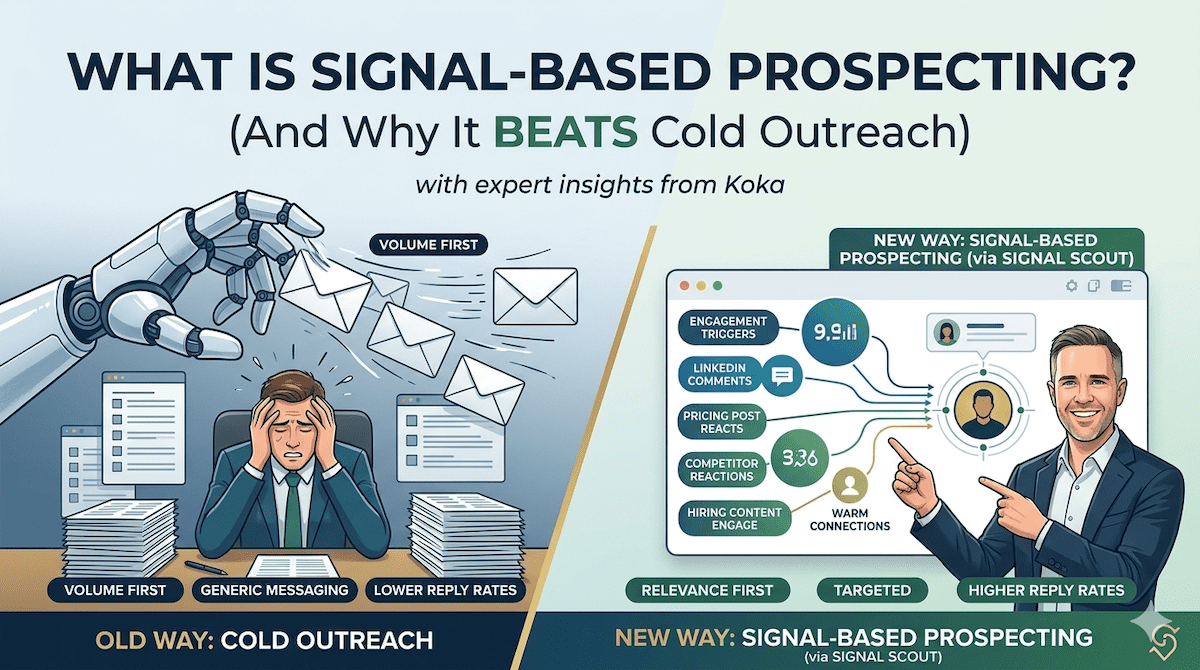
That is the difference between cold outreach and signal-based prospecting. Cold outreach depends on static lists, generic messaging, and volume. Signal-based prospecting depends on engagement triggers, behavioral intent, and public interaction data that tells you a buyer is already leaning in.
Buyers rarely fill out a form as their first move. They self-identify earlier. They comment on a pricing post. They react to a competitor product announcement. They engage with hiring content that suggests a team is expanding.
Here is the practical shift:
| Motion | Cold outreach | Signal-based prospecting |
|---|---|---|
| Starting point | Static account/contact list | Live engagement and intent triggers |
| Message style | Generic, role-based, broad | References the exact behavior or context |
| Prioritization | Volume and sequence capacity | ICP fit plus signal strength |
| Rep experience | More activity, less confidence | Fewer contacts, better timing |
What counts as a buying signal
A buying signal is any observed behavior that increases the probability a prospect is researching, comparing, or moving toward change. Not every signal means “book a meeting now,” but it does mean the buyer has created context you can use.
The most useful signals usually fall into four buckets:
- Content engagement: comments, reactions, shares, saves, and repeat engagement with your posts or your sellers’ posts.
- Competitor motion: engagement with competitor launches, hiring spikes, messaging shifts, or category debates.
- Role and company triggers: new hires, leadership changes, funding, geographic expansion, or team growth.
- Network behavior: consistent interaction patterns across a cluster of people inside the same account or peer set.
This is where LinkedIn is unusually valuable. Public engagement creates visible micro-intent. Someone commenting on a pricing post is different from someone liking a culture post. Someone reacting to a competitor announcement is different from someone casually following a company page. Someone engaging with hiring content may be signaling budget movement or team buildout.

How to capture engagement data systematically
If signal-based prospecting is going to work, it cannot live as screenshots in Slack. It needs collection, enrichment, and activation:
- Collect engagement from company posts, executive posts, seller posts, and competitor-adjacent activity.
- Normalize it into a dataset with profile URL, engagement type, post URL, date, and source.
- Enrich for title, company, firmographics, geography, and ICP fit.
- Score for relevance based on signal type, recency, repetition, and account value.
- Route to the right motion: seller outreach, nurture, retargeting, or watchlist.
Adobe’s 2025 B2B journeys research helps reinforce why this matters. Forty-three percent of B2B practitioners say they are under more pressure to increase content flow, but only 30% prioritize testing for content performance.
This is also where engaged network mapping becomes useful. Instead of looking at one engager in isolation, you map who interacts with your ICP consistently. Which accounts surface repeatedly across seller content, company posts, and competitor conversations?
That map is far more useful than a giant top-of-funnel export. It turns scattered public behavior into a real social selling strategy instead of a random collection of “warm leads.”
The point is not to send more messages. The point is to earn the right message sooner.
Why warm context increases reply rates
Warm context works because it lowers cognitive friction. The prospect does not have to wonder why you reached out. Cold outreach asks the buyer to do all the interpretive work. Signal-based outreach answers those questions up front: “You engaged with our post on pricing tradeoffs.” “Your team has been active around competitor messaging.” “I noticed your VP commented on a workflow problem we solve.”
That changes the emotional posture of the interaction. It feels less like interruption and more like continuation.
Salesforce’s 2026 State of Sales report says nine in 10 sales teams use agents or expect to within two years. AI and automation are making it easier to prep, personalize, and act quickly on context. But the technology is not the edge by itself. The edge is choosing signals worth acting on.
For CMOs building a pipeline acceleration framework, this matters because better context improves more than replies. It improves routing, sales confidence, and personalization quality.
How Signal Scout operationalizes this
Signal Scout operationalizes visible behavior:
- Capture public engagement and competitor-adjacent activity.
- Enrich profiles and accounts for ICP match.
- Cluster signals into engaged network maps.
- Trigger outreach and plays that reference the exact signal shown.
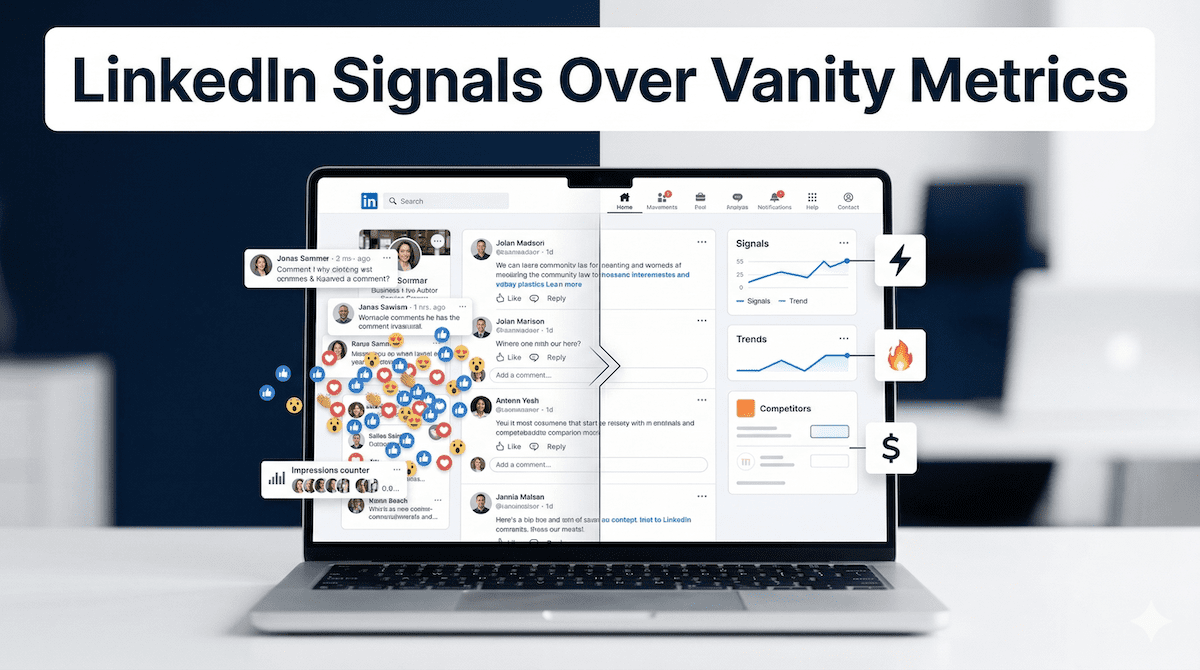
That is why it fits naturally with LinkedIn Signal-to-Pipeline for B2B GTM Teams, LinkedIn Signals Over Vanity Metrics, LinkedIn Engagement Funnels, and a broader B2B Social Selling Expert motion.
For CMOs, that means outreach gets reframed. It stops being a brute-force top-of-funnel task and becomes a relevance system.
If your team is still leading with cold lists and generic copy, you do not have an outreach problem. You have a context problem. Fix that, and signal-based prospecting becomes one of the highest-leverage upgrades in your social selling strategy.
Talk with Koka about turning signals into qualified pipeline

Featured Videos from Learning Paths
One quick watch from each curated path.