





B2B Messaging That Converts: How to Move From Features to Buyer Context
TL;DR:
- Most B2B messaging describes what the product does instead of what the buyer needs to hear at their stage
- The shift: features describe capability, messaging describes context — what the buyer loses, gains, or avoids
- A messaging framework maps positioning, value props, proof points, and channel-specific variants into one hierarchy
- Teams with documented messaging frameworks see 2x conversion rates on content and campaigns
- Messaging frameworks need quarterly refreshes as market conditions, competitors, and buyer priorities shift
The Feature Trap
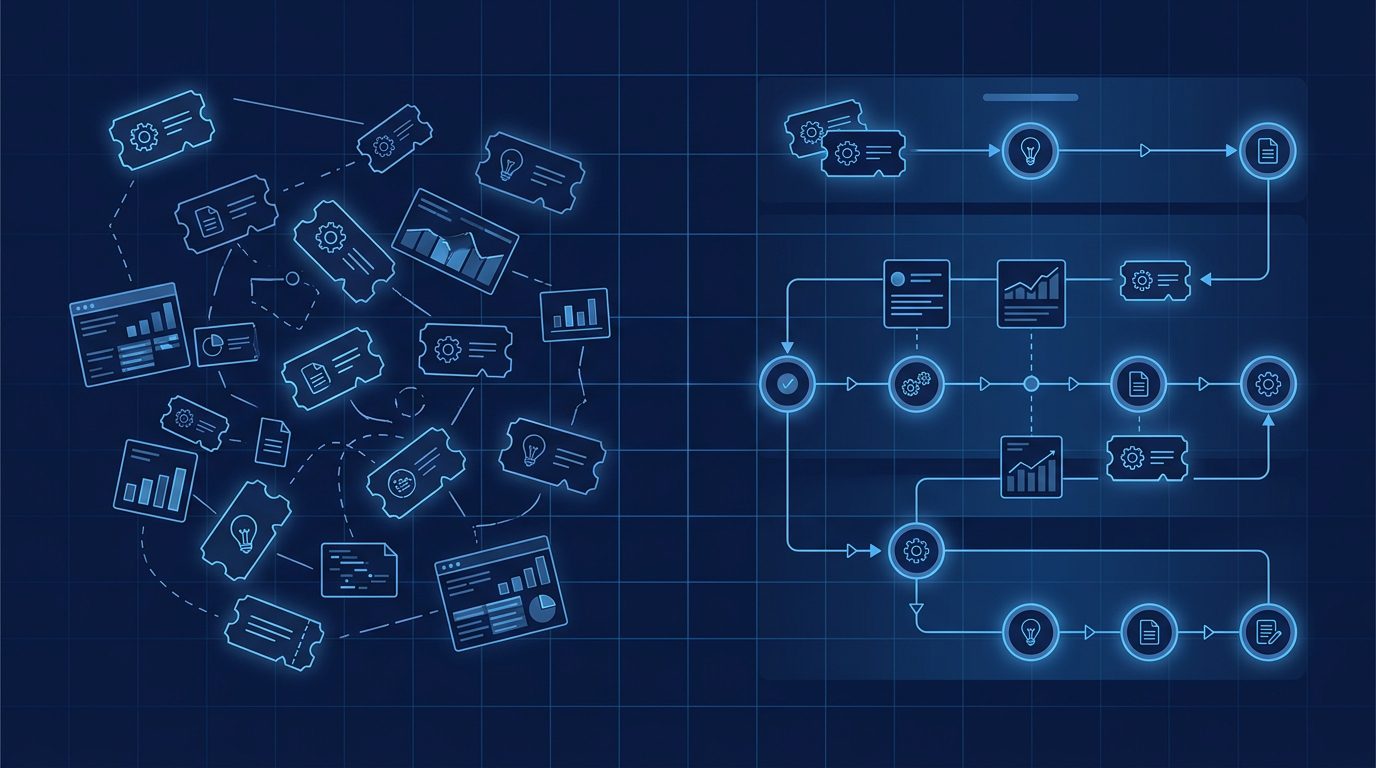
Open any B2B website and you’ll see it within three sentences: “We help companies streamline their workflow with AI-powered automation.” That’s a feature description dressed up as messaging. It tells the buyer what the product does. It doesn’t tell them why it matters to them.
The difference between messaging that converts and messaging that gets scrolled past is one shift: moving from describing your capability to describing the buyer’s context. What problem are they feeling right now? What happens if they don’t solve it? What changes for them when they do?
This is why messaging frameworks for marketing leaders exist. They force the discipline of organizing messaging around buyer reality instead of product features.
The Four-Layer Messaging Hierarchy
A messaging framework organizes the conversation into four layers, from top-level positioning to channel-specific execution. Each layer serves a different purpose and a different audience.
Layer 1: Core Positioning
One sentence that answers: what market do you own, and what belief do you challenge? The positioning statement is not a tagline. It’s the internal compass that every layer below references.
- Market definition: the category you compete in
- Target buyer: the specific person who decides
- Unique belief: the contrarian bet your messaging is built on
- Proof mechanism: why the belief is true (data, case, framework)
Layer 2: Value Propositions by ICP Segment
Different ICPs want different outcomes. The VP of Sales cares about pipeline velocity. The CRO cares about forecast accuracy. The CEO cares about revenue predictability. A messaging framework captures each segment’s primary outcome and the specific value your solution delivers for that outcome.
Layer 3: Proof Point Library
Every value proposition needs evidence. The proof point library collects case studies, statistics, analyst data, customer quotes, and competitive comparisons organized by ICP and buying stage. This library feeds every layer below.
Layer 4: Channel-Specific Variants
LinkedIn posts need a different voice than landing pages. Email sequences need different framing than sales decks. But they should all trace back to the same positioning and value props. The messaging framework ensures consistency while allowing channel-appropriate adaptation.

“Most teams don’t have a messaging problem. They have a framework problem. The words are fine. The logic connecting them to the buyer is missing.”
Building the Framework
A messaging framework takes 2-3 weeks to build with the right inputs. The process is systematic, not creative. If you’re guessing at what resonates, you’re building a message for yourself, not for your buyer.
- Analyze buyer voice data. Review sales call transcripts, support tickets, win/loss reports, and customer interviews. Extract the exact language buyers use to describe their problem, their desired outcome, and their evaluation criteria. This raw language is the raw material of your messaging.
- Map competitive positioning. Document how competitors position themselves and where the gaps are. The best messaging occupies a position no competitor claims.
- Draft positioning and value props. One positioning statement. Three ICP-segmented value propositions. Each value prop has one supporting proof point. No more.
- Test and refine. Run the drafts past 3-5 existing customers. If they don’t recognize themselves in the language, the framework needs adjustment.
Done right, a messaging framework transforms every downstream output — from content and messaging to campaign copy to sales enablement. It becomes the single source of truth that prevents the “two different versions of the same company” problem that plagues scaling B2B teams.
with documented framework
a complete framework
messaging refreshes
Where Voice of Customer Data Fits
The best messaging frameworks are built on real buyer language, not marketing intuition. This requires buyer insight reports that capture what prospects actually say, not what you think they say. The gap between internal assumptions and external reality is where most B2B messaging goes wrong.
Voice of customer campaigns provide the data that turns messaging from guesswork into a repeatable system. Every customer interview, every sales call transcript, every support ticket is a messaging insight waiting to be extracted.
Apply the Framework Before You Build More Content
If you’re creating content without a messaging framework, you’re producing noise. Stop. Build the framework first — one positioning statement, three ICP-specific value props, a proof point for each. Then create content that traces back to that foundation.
Here’s what that shift looks like in practice. A team that builds a messaging framework for a new ICP typically sees their email open rates climb from baseline to 30-40% within the first 60 days. Not because the subject lines got better. Because the language started matching what the buyer was already thinking.
Build Your Messaging Framework → Free Strategy Session
Testing and Iterating Your Framework
A messaging framework is not a one-time document. It is a hypothesis until proven by market response. The fastest way to validate or invalidate messaging is to put it in front of buyers and measure what resonates.
Run a three-week test cycle. Week one: deploy the new positioning in LinkedIn posts and measure engagement patterns. Week two: use the new value props in sales discovery calls and track which ones generate the strongest reactions. Week three: write email sequences using the new messaging and compare open and reply rates against the previous version. Three weeks of testing across three channels will tell you more about your messaging effectiveness than three months of internal debate.
The most common finding in these test cycles is that one or two value props dramatically outperform the others. This is valuable data. It tells you not just what to lead with, but what to cut. A messaging framework with one strong value prop and one supporting proof point is more effective than a framework with four equally weighted value props. Focus creates resonance. Coverage creates noise.
After the test cycle, update the framework and run it again in 90 days. Market conditions shift. Competitors reposition. Buyer priorities evolve. A messaging framework that sits unchanged for a year is costing you pipeline, whether you know it or not.
We’ll audit your current messaging in 30 minutes