I Replaced My Marketing Busywork With AI Agents. Here is the Architecture.
Koka Sexton
Ask AI →
# I Replaced My Marketing Busywork With AI Agents. Here’s the Architecture.
**TL;DR:** I spent the last six months building a team of AI agents to handle research, drafting, editing, repurposing, and analytics across my content properties. The result: 3x more content output, faster turnaround, and — counterintuitively — better quality. Here’s the architecture, the build order, and the one thing most people get wrong when they try this.
—
Last year I hit a wall that every solo operator eventually hits. I was running five content properties, a newsletter, a social presence across LinkedIn and X, and a consulting pipeline. The content was good. The strategy was solid. But I was the bottleneck.
Every article needed me to research. Every draft needed me to write. Every post needed me to approve. The math stopped working somewhere around property number three. There are only so many hours in a week, and I was spending most of them on work that someone — or something — else should have been doing.
So I did what any reasonable person with a systems-thinking problem would do. I didn’t hire. I architected.
3x
Content output increase after deploying agent architecture across all properties
15
Specialized AI agents running distinct marketing functions across content, demand gen, social, and analytics
6 mo
Build time from first agent to full operating architecture
## The Architecture: Agents as Team Members, Not Tools
Here’s the first thing I learned, and it’s the thing most people get wrong: **an AI agent is not a chatbot you talk to. It’s a defined function with inputs, process, quality gates, and outputs.** The difference is the same as the difference between “I asked my friend for advice” and “I hired a VP of Marketing.” This is the framework I built SignalScout’s content pipeline on, and it’s the same approach I used when scaling content operations at LinkedIn. One is a conversation. The other is a role.
When I started building, I organized agents the same way I’d organize a marketing department. Content. Demand Gen. Social. Analytics. Each team has human roles — strategist, manager, analyst — and each team has agents that own specific, repeatable functions.
“An AI agent is not a chatbot you talk to. It’s a defined function with inputs, process, quality gates, and outputs.”
— Koka Sexton
The Content Team is where I started, and it’s where I’d tell anyone to start. I wrote about the broader content engine philosophy here — this is the tactical agent layer that runs on top of it.
## Content Agents: The Five That Actually Ship Work
The Content Team has five agents. Each one owns a specific stage of the content lifecycle.
**The Research Agent** is the foundation. Before I built it, every article started with me spending 45 minutes searching, reading, and compiling notes. Now the agent pulls competitive SERP data, grades sources by quality tier, identifies gaps nobody else is covering, and delivers a structured brief. It doesn’t write. It prepares. And it’s better at source-grading than most junior researchers — it catches the “82% of marketers say” stats that don’t hold up under scrutiny.
**The Drafting Agent** takes that brief and produces a structured first draft with voice, formatting, SEO targets, and internal links already mapped. This is the agent people think they already have because they used ChatGPT once. They don’t. A real drafting agent knows your brand voice, your content architecture, and your editorial standards. The output isn’t publishable — that’s what the editor agent is for — but it eliminates the blank page. My editor went from producing two pieces a week to reviewing and sharpening six to eight.
The Build Order That Actually Works
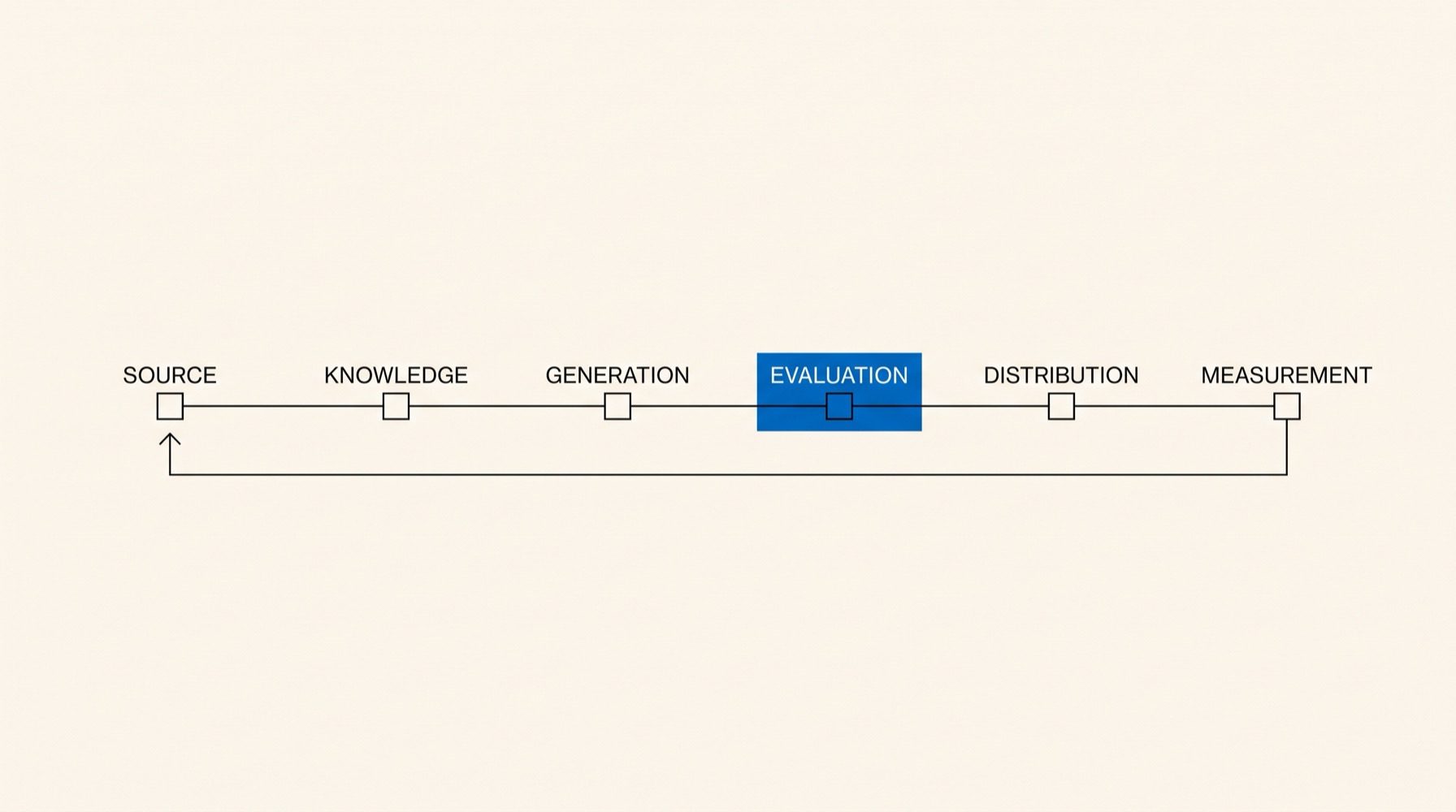
Research → Drafting → Editor → Repurposing → Analytics
Start with research. Everything downstream depends on quality inputs.
1
Research Agent
Pull competitive SERP data, grade sources by quality tier, and deliver a structured brief. Build this first — everything downstream depends on quality inputs.
2
Drafting Agent
Produce structured first drafts with brand voice, formatting, SEO targets, and internal links mapped. Eliminates the blank page so your editor reviews instead of creating from scratch.
3
Editor Agent
Three-pass quality gate: revise for structure, edit for voice and readability, proofread for grammar and encoding. Scans for AI fingerprint patterns and verifies every stat traces to a named source.
4
Repurposing Agent
Transforms one long-form article into LinkedIn posts, Twitter threads, newsletter snippets, and carousel outlines. One asset becomes 10–15 derivative pieces automatically.
5
Analytics Agent
Monitors every published asset for performance signals and feeds learnings back into the other agents. The compounding layer that makes the whole system smarter over time.
**The Editor Agent** is the quality gate. It runs three sequential passes — revise for structure, edit for voice and readability, proofread for grammar and encoding. It checks Flesch reading scores. It scans for AI fingerprint patterns. It verifies that every stat traces back to a named source. This is not optional. Without it, you’re publishing first drafts. I learned this the hard way when I shipped an article with raw JavaScript exposed on the page because nobody had run the encoding check. The editor agent hasn’t missed one since.
**The Repurposing Agent** takes one long-form article and produces every derivative format. LinkedIn posts with the right hook structure. Twitter threads under 230 characters. Newsletter snippets. Carousel outlines. The bottleneck in content distribution isn’t ideas — it’s reformatting. This agent eliminates the reformatting. One article becomes 10-15 derivative assets in roughly the same time it used to take to format two.
**The Analytics Agent** is the one I built last, and it’s the one that compounds hardest. It monitors every published asset for performance signals — traffic trends, CTR changes, content decay — and proactively flags what needs attention. More importantly, it feeds learnings back into the other agents. When the analytics agent detects that specific-stat hooks outperform question hooks on LinkedIn by 30%, the drafting agent and the repurposing agent both get smarter. The whole system learns.
## Demand Gen: The Agents That Fill the Pipeline
The Content Team produces. The Demand Gen Team distributes and converts. This is where I built three agents that handle the revenue side of marketing.
**The SEO Optimization Agent** connects to Google Search Console and GA4 to identify striking-distance pages — content ranking positions 4-15 with high impressions but low CTR. It recommends specific fixes: title rewrites, meta description updates, content refreshes. Then it measures whether the fixes worked and adjusts the priority model. This is not a set-and-forget tool. It’s a continuous improvement loop.
**The Outbound Pipeline Agent** runs a five-stage sequence on target accounts: signal scraping, lead prioritization, prospect profiling, hook writing, and sequence building. Before this agent existed, outbound was manual research, manual enrichment, manual drafting. Now it’s systematic. The agent validates data freshness, runs ICP filtering, and produces sequences that don’t sound like they were written by a template — because each one is built from actual signals, not a static script.
**The CRM Agent** handles the unglamorous work of keeping contact data current. It enriches leads from LinkedIn exports and engagement data, updates status fields, and logs every interaction. The Notes field in my CRM used to be the thing I’d forget to update for weeks. Now every touchpoint is logged automatically.
## Social: Agents That Monitor, Publish, and Grow
The Social Team has four agents, and they’re the ones that protect my time the most. Social media is an infinite attention sink. Without agents, you’re either always-on or invisible.
**The Signal Intelligence Agent** scans target accounts for buying signals — hiring in growth roles, funding rounds, leadership changes, tech stack adoption. It prioritizes by urgency and logs findings directly to the CRM. When a prospect hires a VP of Demand Gen, I know within 48 hours.
**The Social Publishing Agent** handles scheduling and formatting across LinkedIn and X. It doesn’t just queue posts — it enforces platform rules. Twitter threads stay under 230 characters. LinkedIn posts with links get a thumbnail attached. These are rules I used to check manually and sometimes miss. The agent doesn’t miss.
**The Growth Agent** manages audience-building tactics — engagement patterns, profile optimization, content mix calibration. It’s the least mature agent in my stack, and I’ll be honest about that. Growth on social is harder to systematize than content production. But even directional guidance (“your hook format X is outperforming Y by 40%”) is worth having.
**The Engagement Agent** classifies inbound replies from outbound campaigns — interested, objection, not now, referral, unsubscribe — and drafts responses in my voice. The SLA timers are built in: interested replies get a draft within an hour. Referrals get routed within two. Unsubscribes are processed immediately.
Koka Sexton
B2B Marketing · Revenue Architecture
1h ago
I spent 6 months building AI agents to replace my marketing busywork. 15 agents. 4 teams. Content, Demand Gen, Social, Analytics. The result: 3x content output, faster turnaround, and — counterintuitively — better quality. The one mistake everyone makes: starting with drafting instead of research. Build the research agent first. Everything else depends on quality inputs.
247 Likes · 58 Comments
## What I Got Wrong
I made three mistakes building this architecture. They’re worth naming because they’re the mistakes everyone makes.
**First, I started with drafting instead of research.** I wanted the output. Everyone wants the output. But drafting without quality research produces generic AI content — the stuff that reads like it was written by someone who skimmed three blog posts and called it a day. Build the research agent first. Everything else depends on quality inputs.
**Second, I underestimated the editor agent.** I thought “I’ll just review things myself, how bad could the drafts be?” The drafts were fine. The problem was volume. When you go from two articles a week to eight, you can’t review eight articles a week. The editor agent isn’t a nice-to-have. It’s the thing that lets the drafting agent exist without destroying your quality.
**Third, I treated agents as one-off builds instead of living systems.** An agent that ships and never improves is just automation. An agent that learns from data — that gets smarter every time the analytics agent feeds back results — is infrastructure. Build the analytics agent sooner than you think you need it. It’s the compounding layer that makes everything else better over time.
Key Takeaway
Agents that learn from data get better every week. Agents that ship and never improve are just automation wearing an AI label. Build the analytics feedback loop first — it’s the compounding layer that makes every other agent smarter.
## Where This Goes Next
The agent architecture I have today is 15 agents across four teams. In six months, it’ll be 20. The ones I’m most interested in building next are the Experimentation Agent — the one that designs A/B tests across email, landing pages, and social — and the Insight Agent that aggregates cross-channel performance data and surfaces anomalies before I notice them.
But here’s what I actually believe: the number of agents doesn’t matter. What matters is the architecture. If you organize agents around discrete functions with clear inputs and outputs, quality gates between stages, and a learning loop that makes every agent smarter over time, you’re building something that compounds. If you just bolt ChatGPT onto your workflow and call it innovation, you’re not.
The gap between those two approaches isn’t a feature gap. It’s a category gap. And it’s going to separate content teams into winners and everyone else over the next 12 months.
*If you’re ready to build the research agent first: my guide to building AI that works like you covers the same architecture I used to train my agents on voice, style, and editorial standards.*
Automation handles the busywork but you still need someone setting the strategy and building the pipeline architecture. fractional marketing leadership.