





TL;DR: Most B2B content teams create one asset, publish it once, and move on. That is leaving 90 percent of the value on the table. A proper content repurposing system turns every long-form piece into 12 distinct assets across formats, channels, and funnel stages — and AI makes this scalable without losing quality. Here is the exact system I use, from asset decomposition to channel-specific formatting to the AI prompts that do the heavy lifting.
The One-and-Done Content Trap
I have watched B2B marketing teams burn six figures a year on content that gets published once and forgotten. A research report takes six weeks to produce, gets one email send and two social posts, then disappears into the resource library forever. This is not a content quality problem — it is a content operations problem.
When I was running content for large B2B organizations, I learned something that changed how I think about content ROI: the value of a content asset is not in its creation. It is in its distribution. And distribution does not mean posting the same link four times. It means decomposing one asset into native-first formats for every channel where your buyers spend time.
The Asset Decomposition Framework
Every long-form asset — a blog post, a research report, a webinar recording, a podcast episode — contains multiple atomic pieces of value. The job of a repurposing system is to extract those pieces and reformat them for different channels and consumption modes.
Here is how I break down one asset. Start with a 2,000-word blog post like this one. Inside that single article, you have:
- A core thesis — the central argument or framework (500 words)
- Data points and statistics — quantified proof points (3-5 per article)
- Process steps — actionable how-to sequences (one framework per article)
- Contrarian takes — opinions that challenge conventional wisdom
- Examples and stories — anecdotes that make the abstract concrete
Each of these pieces can become its own asset. The core thesis becomes a LinkedIn carousel. The data points become individual social posts with charts. The process steps become a one-page PDF checklist. The contrarian take becomes a short-form video script. The examples become case-study snippets for your sales team's enablement library.
Content repurposing is not about copying and pasting the same message into different formats. It is about identifying the atomic units of value in a piece and delivering each one in the format that maximizes its impact on a specific channel, for a specific audience, at a specific stage in the buyer journey.
The 12-Asset Output Map
Here is the exact map I use to turn one long-form asset into twelve. This is not theoretical — I have run this system for my own content and client content across dozens of pieces:
My Actual AI Repurposing Workflow
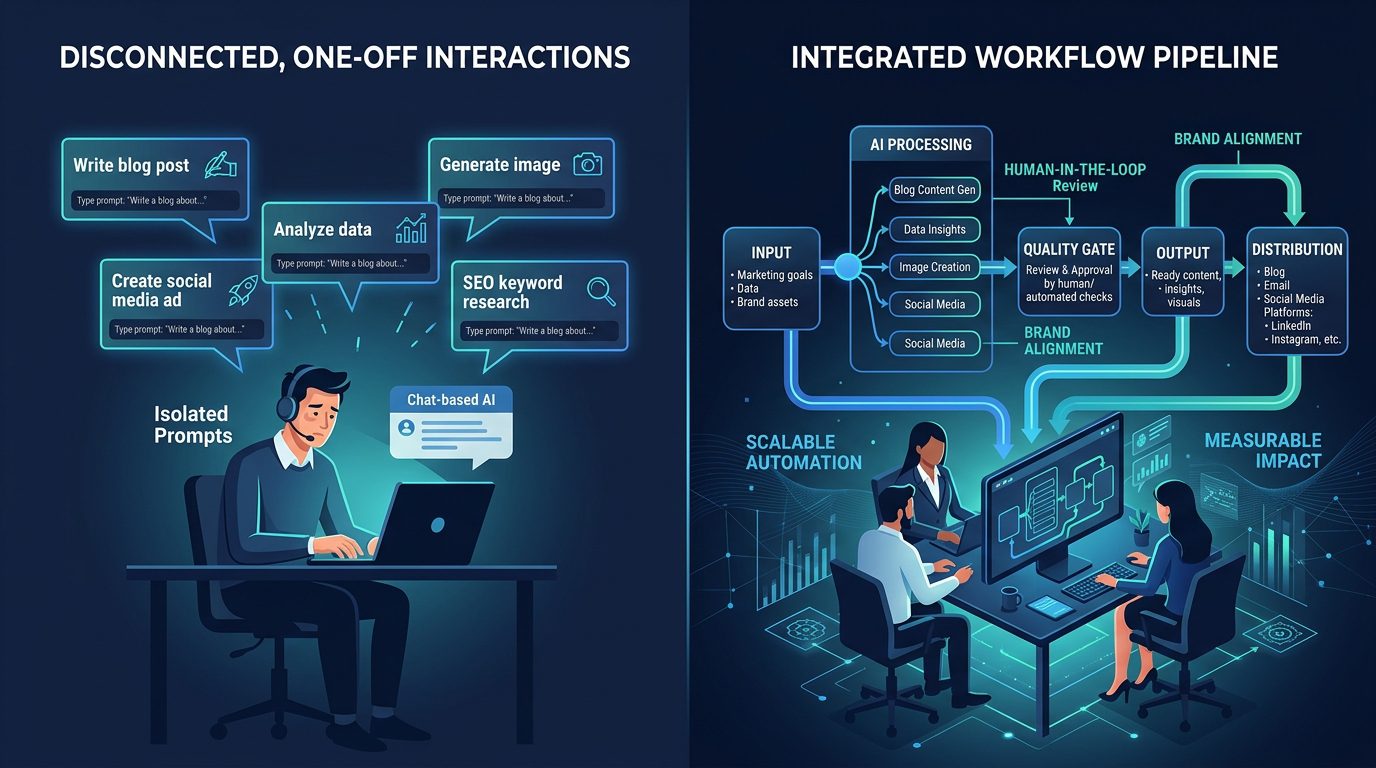
Here is where I get practical. I have built a content repurposing workflow inside Make that handles 80 percent of the decomposition automatically. The remaining 20 percent is human review — checking voice consistency, fixing formatting, and adding the personal touches that make content feel human.

The system works in three stages:
Stage 1: Decomposition (AI-Powered)
When a new article is published, an automation pulls the content and runs it through a decomposition prompt. The prompt identifies the core thesis, the 3-5 key data points, the process steps or framework, and any contrarian opinions. It outputs a structured JSON that becomes the source for all downstream assets.
The prompt I use looks something like this: “Extract from this article: (1) the one-sentence core thesis, (2) 3-5 data points with full context, (3) any step-by-step frameworks or processes, (4) the most contrarian opinion stated, (5) a 2-sentence example or story that illustrates the main point.” This gives me a clean JSON object with five extracted components.
Stage 2: Format Transformation (Channel-Specific)
Each extracted component is then fed through a channel-specific formatting prompt. The LinkedIn post prompt is different from the Twitter thread prompt, which is different from the email newsletter prompt. Each channel has its own syntax, tone, and optimal length.
For example, the LinkedIn post prompt specifies: 1,200 characters max, hook in the first line, no external links in the main body (put them in comments), end with a question to drive engagement. The email prompt is completely different: 400-600 words, personal greeting, teaser format, primary CTA is click-through to the full article.
Stage 3: Human Review (Quality Gate)
Every AI-generated asset goes through a 5-minute human review before publishing. I check for voice consistency (does this sound like me?), factual accuracy (did the AI hallucinate a stat?), and formatting (does it display correctly on the target platform?). This is not optional. AI-generated content without human review is content debt — it looks fine until it suddenly does not.

Content repurposing without a system is just busywork. Content repurposing with a system is a revenue multiplier. The difference: having a decomposition framework and an AI-powered workflow that turns one asset into twelve without burning your team out.
The Economics: Why Repurposing Beats Creating from Scratch
Let me put numbers to this. A single high-quality B2B article takes roughly 8-12 hours to research, write, edit, and publish — whether you are writing it yourself, using a writer, or using AI with heavy editing. If you pay a skilled B2B writer $500-1,500 per article, that is your creation cost.
If you publish that article and do nothing else, you have spent $500-1,500 for one asset that reaches one audience on one channel. If you run it through a repurposing system and generate 12 assets, your effective cost per asset drops to $40-125. And those 12 assets reach different audiences on different channels at different funnel stages.
The math is not complicated. But most teams over-index on creation and under-index on distribution. They would rather commission a new article than squeeze the full value out of the one they already have. This is why content ROI conversations are always about “we need more content” instead of “we need to distribute the content we have.”
What Most Teams Get Wrong
I have seen three failure patterns in content repurposing, and they all trace back to the same root cause: treating repurposing as an afterthought instead of a system.
Failure 1: Copy-paste repurposing. Taking the same 2,000-word article and pasting it into LinkedIn as a post does not count as repurposing. It counts as lazy. Each channel has its own grammar. LinkedIn posts are not blog posts with shorter paragraphs. Twitter threads are not LinkedIn posts with character limits. Format for the channel or do not bother.
Failure 2: No decomposition. Trying to repurpose the whole asset instead of its atomic pieces. The whole article does not belong in a podcast. The whole webinar does not belong on LinkedIn. Extract the pieces that fit each format, and leave the rest.
Failure 3: No human review gate. Running AI repurposing on autopilot without a review step. I have seen AI-generated LinkedIn posts attribute the wrong stat to the wrong source, use the wrong tone, or — worst of all — fabricate a quote that the author never said. The review step is five minutes. The reputational cost of skipping it is not worth the “efficiency.”
Build This in One Afternoon
You do not need a massive tech stack. Here is the minimum viable setup:
- Source content: Your blog, CMS, or a Notion database of articles
- Automation layer: Make or n8n to connect your CMS to an LLM and handle format routing
- AI layer: An LLM (Claude API, GPT-4o, or DeepSeek for cost efficiency) with channel-specific prompts
- Review layer: A Slack channel or Notion page where AI-generated drafts land for 5-minute human review
- Distribution: Your social scheduler (Buffer, Hootsuite, or native scheduling) and email platform
Set up the automation once, tune the prompts for your voice, and content repurposing stops being a thing you “should do” and becomes a thing that just happens. That is the difference between a content strategy and a content system. I covered the broader architecture in Build a Social Selling System, Not a Hustle — the same principle applies: systems compound, one-off effort does not.
If you want help building a repurposing system that runs on autopilot — including the Make scenarios and AI prompts calibrated to your brand voice — let us build it together. Most teams can go from zero to a working repurposing pipeline in a single working session.