





Your lead scoring model is lying to you.
Not because it’s poorly built. Because it was designed for a world that no longer exists—a world where B2B buyers filled out forms, downloaded whitepapers, and waited patiently for an SDR to call. That world evaporated somewhere around 2020, and yet here we are in 2026, still optimizing MQL models like it’s 2015.
The shift is already happening. Leading revenue teams have abandoned demographic-fit scoring in favor of signal-first go-to-market. They’re not looking at job titles and company size. They’re looking at what buyers actually do—engagement depth, dwell patterns, comment quality, cross-channel behavior. And they’re generating 3.5x more pipeline because of it.
Here’s how to rebuild your GTM engine around signals instead of scores.
TL;DR
- Traditional MQL scoring based on demographic fit misses the buying signals that actually predict revenue
- Signal-first GTM tracks engagement depth, cross-channel behavior, and intent patterns to identify ready-to-buy accounts
- Three-phase framework: signal capture → signal scoring → signal activation, with a 48-hour window to act before intent decays
- Companies using signal-first qualification generate 3.5x more pipeline than those relying on traditional lead scoring models
70%
of B2B buyers do research before talking to sales
3.5x
more pipeline from signal-qualified vs MQL leads

48h
window to act on a buying signal before it goes cold
The MQL Is a Lagging Indicator
Let’s be honest about what an MQL actually measures. Someone filled out a form. That’s it. You’ve dressed it up with demographic scoring, lead grading, and engagement thresholds, but at its core, an MQL is just a form fill with enough points attached to justify an SDR call.
The problem? 70% of B2B buyers complete their research before ever talking to a sales rep. By the time they fill out your form, they’ve already read your competitor comparisons, watched your product demos, reviewed your pricing, and formed an opinion about whether you make the shortlist.
Your MQL model isn’t identifying buyers. It’s identifying the moment buyers decide to identify themselves—which is usually the last 20% of their journey.
This is worse than inefficient. It’s actively costing you pipeline. When you wait for form fills, you enter the conversation after the buyer has already done their research, formed their opinions, and built their shortlist. You’re not influencing the decision. You’re reacting to it.
Signal-first GTM inverts this. Instead of waiting for the buyer to raise their hand, you’re watching for the behavioral signals that indicate active buying intent—and you’re engaging before the shortlist is locked.
What Signals Actually Predict Revenue
Not all signals are created equal. A whitepaper download from a college student isn’t the same as a pricing page visit from a VP at a target account. Signal-first GTM requires signal discipline: knowing which behaviors correlate to closed revenue and which ones are just noise.
Here are the signal categories that actually matter:
- Engagement depth, not breadth. One person spending 15 minutes on your case studies is worth more than 50 people spending 30 seconds on a blog post. Track dwell time, scroll depth, and content consumption patterns—not page view counts.
- Competitive research behavior. When a prospect visits your competitor comparison pages, pricing page, and integration documentation in the same session, they’re building a shortlist. That’s not an MQL. That’s a buying signal.
- Social engagement quality. Someone who comments with specific questions on your CEO’s LinkedIn posts is a different signal than someone who likes three posts in a row. Track comment substance, not engagement volume.
- Cross-channel patterns. The same person visiting your website, engaging on LinkedIn, and opening your email sequence within a 72-hour window isn’t three separate touchpoints. It’s one accelerated buying signal.
- Organizational velocity. Multiple people from the same company engaging with your content across channels within a compressed timeframe—that’s buying committee activation, not coincidence.
Signal Capture: Beyond Form Fills
You can’t act on signals you can’t see. The first phase of signal-first GTM is building the infrastructure to capture buying signals before they become form fills.
This requires three things most marketing teams don’t have:
1. De-anonymized website intelligence. You need to know which companies are on your site, what pages they’re visiting, and how long they’re staying—before they fill out a form. Tools like Apollo.io make this possible at scale, identifying accounts by IP and appending firmographic data in real-time.
2. Social listening with intent detection. Not brand mentions. Buying signals. When someone comments on your thought leadership with a specific, research-oriented question, that’s intent. Your CRM should know about it within hours.
3. Third-party intent data integration. Technology installation monitoring, job change tracking, funding announcement monitoring—these external signals often surface intent weeks before the buyer touches any of your owned channels.
The goal of signal capture isn’t to build a bigger database. It’s to surface the accounts that are actively in-market right now so you can engage before they talk to your competitors.
Signal Scoring: Intent Over Identity
Once you’re capturing signals, you need a scoring model that weights intent behavior over demographic fit. This is the biggest mindset shift in signal-first GTM.
Traditional lead scoring asks: “Does this person match our ideal customer profile?”
Signal scoring asks: “Is this person showing buying behavior right now?”
A Director at a $50M company actively researching your product is more valuable than a VP at a $5B company who accidentally clicked your ad. Signal trumps title. Every time.
Build your signal scoring model around three dimensions:
- Signal type weight. Pricing page visit > case study > blog post. Comment on CEO content > LinkedIn like. Cross-channel engagement > single-channel. Map weights to your actual conversion data, not assumptions.
- Signal velocity. A prospect who visits your pricing page three times in one week is in a different buying stage than someone who visits once a month. Track frequency and recency, not just occurrence.
- Signal decay. Intent has a shelf life. A signal from two weeks ago is worth a fraction of a signal from yesterday. Build time decay into your scoring model so stale signals don’t inflate scores.
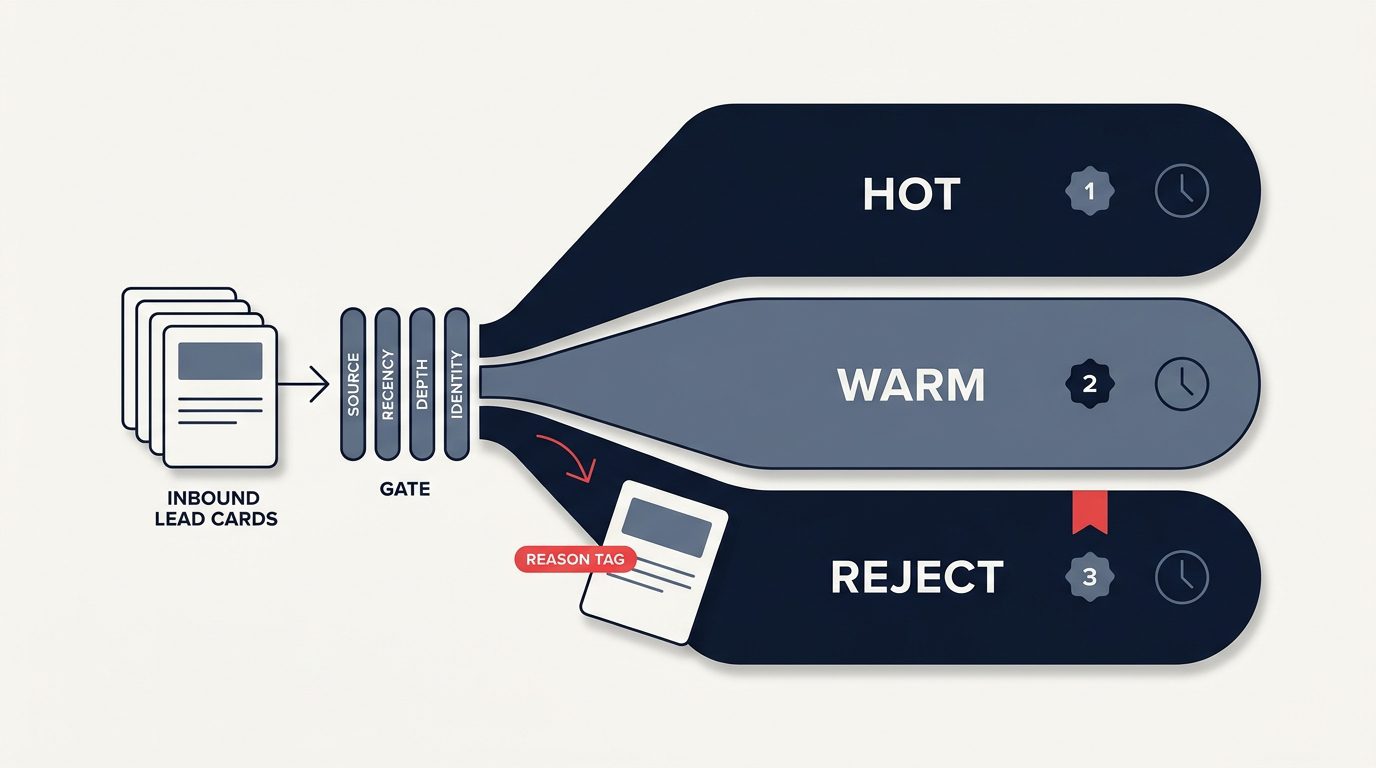
The output isn’t a lead score. It’s a prioritized action list: these accounts need outreach today, these need nurture, and these aren’t ready yet. Your SDRs stop guessing and start executing.
Signal Activation: The 48-Hour Window
Signals decay fast. Research shows the window to act on a buying signal is roughly 48 hours before the prospect moves on, gets distracted, or engages with a competitor who responded faster.
This is where most signal-first programs fail. They do a great job capturing and scoring signals, then let them sit in a dashboard for a week before anyone acts. By then, the signal is cold and the buyer is already in someone else’s pipeline.
Signal activation requires automation:
- Automated routing. When a high-signal account is identified, the right rep gets notified immediately—not in a Monday morning report. The notification includes context: what the prospect looked at, what they engaged with, and a suggested outreach angle.
- Triggered sequences. Signal-qualified accounts enter personalized nurture sequences automatically. Not generic drip campaigns—sequences that reference the specific content they engaged with and the buying signals they demonstrated.
- Multi-threaded activation. When multiple people from the same account show buying signals simultaneously, the system triggers a coordinated outreach strategy—executive-to-executive, champion-to-champion, user-to-user.
The Signal-First Stack
Signal-first GTM isn’t a feature you add to your existing stack. It’s a different architecture. Here’s what the core components look like:
Capture layer: Website de-anonymization, social listening, intent data integration, CRM enrichment
Scoring layer: Real-time signal scoring engine with time decay, cross-channel signal aggregation, account-level intent scoring
Activation layer: Automated routing to sales, triggered multi-channel sequences, real-time alerting with context and recommended actions
Measurement layer: Signal-to-pipeline conversion tracking, time-to-engagement metrics, signal quality scoring (which signals actually predict revenue?)
The stack doesn’t need to be expensive. But it needs to be connected. A signal captured but not scored is useless. A signal scored but not activated is wasted. A signal activated but not measured is a missed learning opportunity.
Start with one signal source. Prove it predicts revenue. Build the activation workflow. Then add the next signal. Don’t try to boil the ocean—signal-first GTM is a muscle you build, not a switch you flip.
The companies winning in 2026 aren’t the ones with the most leads. They’re the ones who know which leads are ready to buy—and act on that knowledge within 48 hours.
Your MQL model served its purpose. But it’s time to build something better. Something that doesn’t just count leads, but actually predicts revenue. That’s signal-first GTM.
Want to see what signal-first GTM looks like for your business? Let’s build your signal architecture.