





TL;DR
- The Myth: Most sales-marketing “alignment” failures are really handoff failures. You can hold all the joint offsites you want and still lose the lead in the gap between teams.
- The Cost: Only 13% of MQLs ever advance to sales-qualified status, and the average company takes 42 hours to respond to a lead that went cold hours ago.
- The Fix: A written handoff SLA built on signal-qualified criteria, not demographic scoring alone.
- The Result: Teams with tight alignment and advanced scoring convert MQL to SQL at roughly double the industry average.
- The Start: Define one shared definition of “qualified,” set response-time commitments, and review the handoff every single week.
The Alignment Retreat Problem
Every year, thousands of B2B companies spend a day or two at a smarketing retreat. Marketing and sales sit in the same room, do the trust exercises, agree on an ICP, and leave with a shared deck and a group photo. A quarter later, marketing is still complaining that sales never follows up on leads, and sales is still complaining that marketing sends garbage. The retreat did not fail because the people were insincere. It failed because alignment is not a feeling you build in a room. It is a contract you enforce in the handoff.
I have watched this exact cycle repeat for years. The problem is rarely that the two teams dislike each other. The problem is that there is no shared, written definition of what a qualified lead is, who owns it at what moment, and how fast it must move. Without that contract, both teams are right and both teams lose.
This is the gap almost nobody names. Companies spend six figures on alignment consulting and zero dollars on the one document that would actually fix the relationship: a handoff service-level agreement. The data backs this up. Research shows that only 13% of marketing-qualified leads ever advance to sales-qualified status across industries, which means 87% of what marketing produces dies in the gap between the two teams, according to Flint’s MQL-to-SQL benchmark research.
Alignment is a byproduct of a good handoff contract, not the cause of it. You do not align two teams by asking them to get along. You align them by writing down exactly what each one owes the other.
The Handoff Is Where Pipeline Dies
The MQL-to-SQL transition is the single most consequential stage in B2B revenue generation, and it is where most pipeline quietly dies. It is also the least owned. Marketing thinks its job ends when the lead is marked qualified. Sales thinks its job begins when the lead is clearly ready to buy. The gap in the middle belongs to no one.
The bigger problem is time. The average company takes 42 hours to respond to a new lead, according to Prospeo’s MQL-to-SQL handoff playbook. By then the buyer has moved on. Classic lead response research has shown for years that responding within the first five minutes dramatically increases your odds of connecting compared to waiting even 30 minutes. A lead that sits for two days is not a lead. It is an artifact.
Here is the part most teams miss. Speed without signal is just faster noise. If marketing hands over every form fill and sales is expected to chase all of them, sellers learn to ignore the queue. The moment a sales team stops trusting the queue, the handoff is dead, and no CRM rollout brings it back. Trust is not rebuilt with a better tool. It is rebuilt with a better definition of qualified.

Signal-Qualified Beats Demographic-Qualified
Most lead scoring models are demographic. They score a lead on title, company size, and industry, then bolt on a few points for pages visited and emails opened. That produces an MQL that looks qualified on paper and means nothing in reality. A VP of Marketing at a 500-person company who downloaded one ebook is not a buyer. They are a researcher with a nice title.

The alternative is signal-qualified scoring. A lead becomes qualified when they show behavior that actually precedes a purchase: repeated engagement with pricing or demo content, visits from multiple stakeholders at the same account, direct replies to outreach, or intent triggers like a hiring spike or a funding event. This is the same principle I have written about before. Social engagement is intent data, and job postings are intent data. The logic is identical for the handoff. Qualify on signal, not on demography, and your MQL-to-SQL conversion stops being a fiction.
There is a measurable payoff to getting this right. Teams that combine advanced lead scoring with tight sales-marketing alignment convert MQL to SQL at a 40% rate, nearly double the industry average, according to Shno’s marketing qualified lead statistics. That is not a marginal improvement. That is the difference between a pipeline that works and one that has to be manufactured every quarter.
What I Actually Think
Here is the part I want you to sit with, because it took me a decade in revenue leadership to learn it and I still see teams get it wrong. The entire sales-marketing alignment industry is solving the wrong problem. Alignment is not the goal. It is a byproduct. The goal is a handoff contract so specific that both teams would sign it with a gun to their head, because it holds each of them accountable.
Early in my career I ran the classic play: monthly alignment meetings, shared dashboards, joint KPIs, the whole ritual. It felt productive and changed almost nothing, because nothing in writing forced a behavior change. The moment I replaced the alignment meetings with a one-page handoff SLA, the bickering stopped. Marketing knew exactly what qualified meant. Sales knew exactly how fast they had to respond and what happened if they did not. We did not need to like each other more. We needed to be accountable to each other more.
Building SignalScout taught me the same lesson from the product side. We built the whole thing around one prioritized signal per account, answered on a fixed rhythm. That is not a feature decision. It is an operating decision. When you constrain what gets measured and who owns it, you constrain what gets done. The same law applies to the handoff between marketing and sales.

Sales and marketing do not need to like each other more. They need to be accountable to each other more. A one-page handoff SLA fixes what a thousand alignment meetings cannot.
Build Your Handoff SLA in Five Steps
A handoff SLA is not a 40-page document. It is one page, written in plain language, that any seller or marketer can read in sixty seconds. Here is the system I run, and it takes one afternoon to write and one weekly meeting to enforce.
Replace the demographic score with signal-qualified criteria. Write one sentence both teams agree on: what behavior, in what window, makes a lead worth a human touch. If it cannot fit in one sentence, it is too vague to enforce.
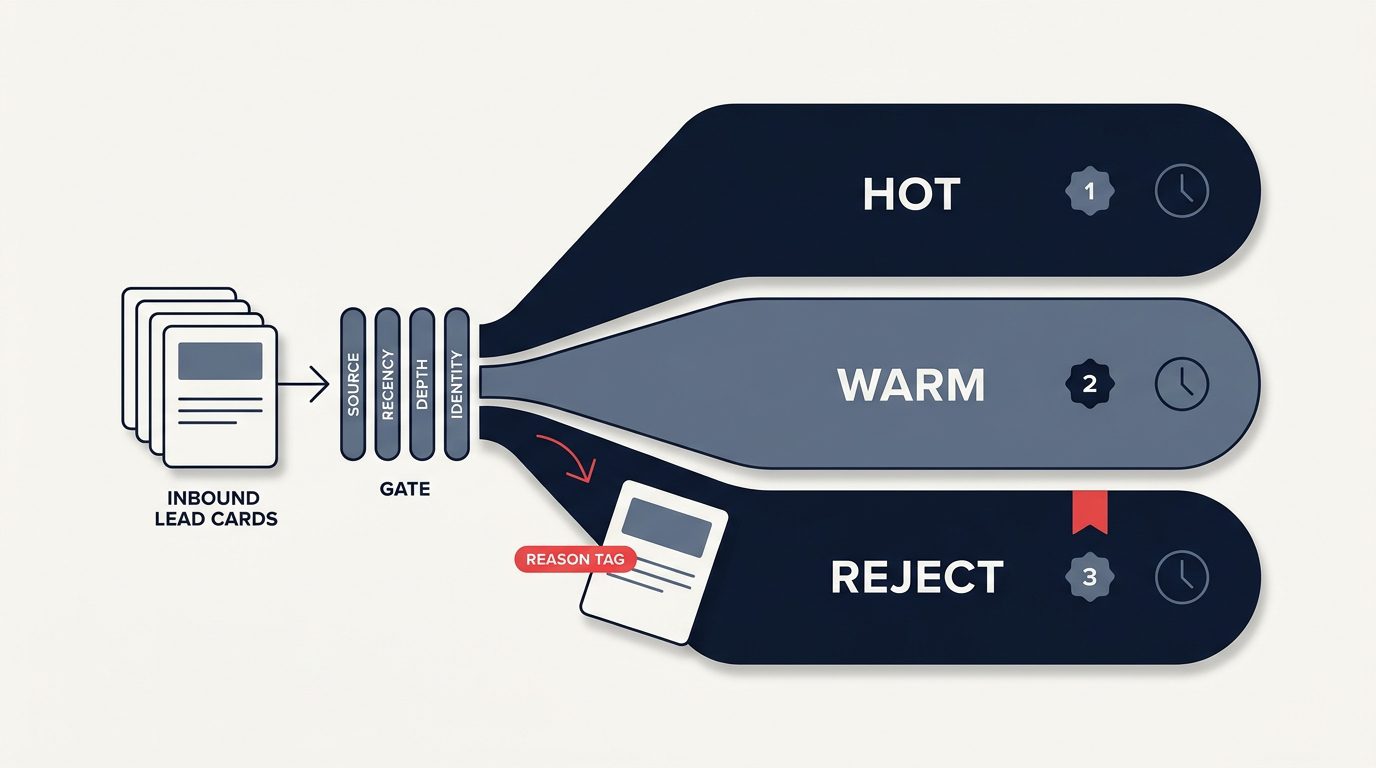
Commit to a tiered SLA: hot signals within five minutes, warm signals same business day, everything else routed to nurture. Put a clock on it. Speed is the highest-leverage variable in the whole handoff.
Sales gets the right to reject a lead, but every rejection must come back with a written reason. That reason feeds the scoring model. Silent rejection is what kills trust, and a lead that is ignored is worse than a lead that is rejected.
One person owns the MQL-to-SQL conversion metric end to end. If nobody is named, the gap belongs to no one and every lead that dies in it is nobody’s fault.
Put the handoff metric on the same weekly revenue cadence you use for pipeline. I have written about why the weekly revenue cadence beats any strategy offsite. The handoff is no different. What gets reviewed every week gets fixed every week.
Here is the shift in one table, old way versus signal-qualified way.
| Element | The Old Way | The Signal-Qualified Way |
|---|---|---|
| Qualification | Demographic score (title plus company size) | Buying behavior plus intent signals |
| Ownership | Marketing owns the MQL, sales owns the SQL, nobody owns the gap | One named owner for the handoff |
| Response | Whenever someone gets to it (average 42 hours) | Five minutes or less for hot signals |
| Rejection | Silent; sales just ignores the lead | Written, with a reason, fed back into scoring |
| Review | Annually, at a retreat | Weekly, in the revenue cadence |
The Contract Is the Alignment
You already have a handoff. It is whatever happens between the moment marketing marks a lead and the moment sales touches it. The only question is whether you designed it on purpose or let it design itself. Most teams let it design itself, and then wonder why pipeline is thin.
Stop scheduling alignment retreats. Write the contract instead. Define qualified in one shared sentence, set a response-time commitment, agree on the rejection loop, name the owner, and review it every week. That is the whole system, and it is the reason some teams convert MQL to SQL at twice the rate of their competitors. The teams that look aligned are not the ones with the best culture. They are the ones with the cleanest handoff.
This is the same discipline I apply to every stage of the funnel. When your pipeline coverage is an illusion and your handoff is a leak, no amount of top-of-funnel volume saves you. You fix the system first, then you pour in the demand.
You do not need better culture to align sales and marketing. You need a one-page handoff contract with a named owner, a response-time commitment, and a weekly review. Fix the handoff and the two teams will look aligned because they finally are.
If you want help building a signal-qualified handoff SLA for your team, let’s talk. I build these systems for B2B teams that are done losing pipeline in the gap between marketing and sales.