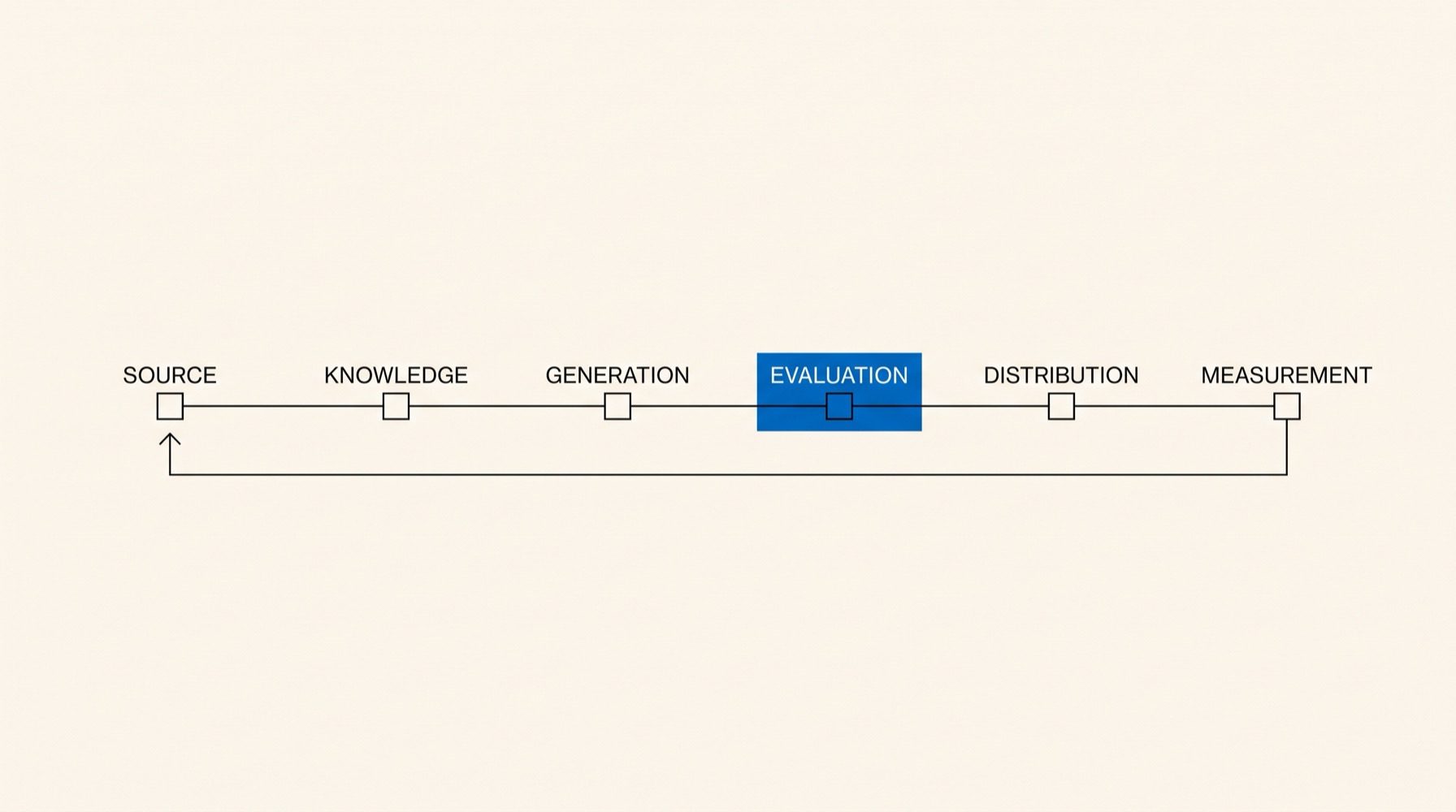






Every B2B team says it does content repurposing. Almost none of them actually do. What most teams do is take last week’s article, paste the opening onto LinkedIn, and call it distribution. The audience gets the same message in the same voice in more places, and it learns to scroll past all of it.
I run a repurposing system across six properties every week. The lesson I keep relearning is simple: an idea is not finished when you publish it. It is finished when you have rebuilt it for every surface where your buyer spends time. The same insight has to become a carousel, a short post, a newsletter section, a podcast clip, and a sales one-pager. Each version has a different shape, a different job, and a different reader.
This is the operating model I use to turn one strong asset into twenty native assets without the copy-paste slop that kills engagement. It is not a prompt library. It is a repurposing workflow.
TL;DR
- The Problem: Most teams “repurpose” by pasting the same post everywhere, which reads as repetition, not reach.
- The Reframe: Repurposing is re-architecture. You rebuild one idea in each channel’s native shape instead of moving a post around.
- The System: One pillar asset can fuel 20+ native formats when you map it deliberately instead of pasting it blindly.
- The Start: Pick your single best asset, map it to five formats, and ship the whole batch within 48 hours.
What Is Content Repurposing?
Content repurposing is the practice of rebuilding one core piece of content into multiple formats, each native to the channel where it appears. It is not republishing, which copies the same asset to a new surface. Repurposing starts from one pillar asset, such as a long article, a webinar, or a podcast episode. It produces derivatives that keep the idea while changing the shape, length, hook, and job of each version.
Copy-Paste Repurposing Is Why Your Content Feels Like Spam
The tell is easy to spot. You open LinkedIn and see the same four-paragraph post from the company blog, cut off at sentence three with a “read more” link. Then you open X and see the same hook compressed. Then the newsletter arrives with the same opening paragraph you already read twice. The brand thinks it is distributing. The audience thinks it is being followed around by a marketer.
This is the copy-paste fallacy. It assumes reach is a function of how many places you post. Reach is actually a function of how well each post fits the place it is in. A LinkedIn post and a newsletter are different media. They have different attention windows, different reading postures, and different jobs in the buyer’s journey. Pasting one into the other ignores all three.
The data shows how badly most teams are doing this. According to the Content Marketing Institute, only 32% of marketers use AI to repurpose content. Even among those, most use it to summarize rather than rebuild. The result is not more reach. It is more of the same message in more places, which the audience learns to skip.
The Reframe: Repurposing Is Re-Architecture, Not Re-Posting
The shift that matters is small to say and hard to do. Stop thinking about the asset. Start thinking about the idea inside it. A 1,500-word article is not the unit of work. The insight, the framework, the number, or the story is the unit of work. The article is just one container for it.
When you re-architect, you ask three questions for every channel before you touch a single word. First, what is this channel’s native shape? A LinkedIn carousel is slide-based and scannable. A newsletter is a long read but a private one. A short video is a face and a voice, not a page. Second, who is the audience here, and what job does the idea do for them? A sales leader reads for pipeline. A founder reads for growth. A practitioner reads for the how-to. Third, what is the one thing this version is allowed to say? A repurposed asset should make a single point, not carry the whole argument.


Repurposing is not copy-paste. It is re-architecture. You do not move a post to another channel. You rebuild the idea in that channel’s native shape, or the audience reads it as noise.
Here is where my thinking diverges from most advice. I have run repurposing across my own content engine for years, and the biggest lesson is counterintuitive. You get more reach from fewer, more deliberate versions than from more, sloppier ones. Paste one post into ten channels and you get ten ignored posts. Rebuild one idea into five native formats and you get five surfaces that actually work.
There is a timing rule I follow almost mechanically: the 48-hour rule. Repurpose within 48 hours of the original publish. That is while the idea is still fresh in the audience’s memory. The original is also still gathering engagement. Wait two weeks and the moment has passed. The topic is cold, the algorithm has moved on, and you are repurposing into a void.
The One-to-Twenty Map
Here is the actual map I use. Start with a pillar asset, the single deepest version of the idea. That is usually a long-form article, a webinar, or a podcast episode. Everything else is a derivative built for a specific surface.
| Format | Native Shape | Job It Does |
|---|---|---|
| LinkedIn carousel | 5-7 slides, one insight per slide | Scannable education, saves the read for later |
| LinkedIn text post | 100-200 words, hook plus one point | Starts a conversation, filters for fit |
| X / Twitter thread | 5-10 short posts | Bites the idea into portable chunks |
| Newsletter section | 300-500 words with context | Deepens the owned audience relationship |
| Short video clip | 60-90 seconds, face and voice | Humanizes the idea, builds trust |
| Email to warm list | Personalized summary plus CTA | Converts warm leads, not cold ones |
| Sales enablement one-pager | One page, buyer-facing | Arms sellers with the idea for calls |
That table is seven formats, and it is not the ceiling. A single webinar can also become a blog post, three blog post sections, a podcast clip, and a slide deck. It can also become a quote graphic and a chapter in a future lead magnet. The point is not to hit twenty every time. The point is to stop treating one asset as one asset.

The 5-Step Repurposing Workflow
The system is simple enough to run in an afternoon, which is the only way you will actually run it. Here is the sequence.
Repurpose your highest-performing asset, not your most recent one. One strong idea rebuilt ten ways beats ten weak ideas published once. Check engagement, comments, and DMs before you pick.
Write down the single insight, the one number, and the one story the asset is built on. If you cannot name the core idea in one sentence, the asset was not repurposable in the first place.
Choose three to seven derivative formats based on where your buyer actually spends time and what each surface is for. Never map a format just because it is easy.
Write each version fresh for its native shape. New hook, new structure, new length. The idea stays the same; the packaging changes completely.
Batch the whole derivative set and release it while the original is still warm. Momentum is part of the strategy, not a nice-to-have.
A Worked Example: One Webinar, Twelve Assets
Abstract systems are easy to nod at and hard to run. So here is a concrete pass. I take a single 45-minute webinar and turn it into a full batch without inventing a new idea from scratch.
The transcript becomes a long-form article, cleaned up and rebuilt as a written argument rather than a spoken one. The three sharpest moments become LinkedIn text posts, each with its own hook. One carousel walks through the core framework, one slide per idea. A 90-second clip states the central claim to camera. The recording becomes a newsletter section with added context for the owned audience. Finally, a sales one-pager arms the team to use the idea on calls.
That is twelve assets from one recording, and none of them are copy-paste. Every derivative is built for a surface the buyer already uses. You are not guessing where demand lives. You are meeting it where it already is, with a version of the idea shaped for that room.
Where AI Helps, and Where It Creates Slop
AI is the fastest accelerator in repurposing, and the fastest way to make your brand sound like everyone else. The line is not about the tool. It is about what you hand it.
Use AI for the mechanical work. Transcribe the webinar with Descript. Pull the key quotes. Draft a first pass of the carousel slides in Gamma. Reformat the blog post into a newsletter layout. This is where it saves hours and rarely hurts. Do not hand AI the voice. The moment you ask a model to “rewrite this for LinkedIn,” you get a flat, personality-free paragraph. Ten thousand other brands posted the same one this week. I covered the full argument in my piece on the content quality stack, and the lesson carries over. Quality is a control layer, not an accident.
The practical fix is a repurposing board. I keep every asset and its derivatives in a single Notion database, one row per idea, with a column for each format and its status. Nothing gets repurposed twice, and nothing worth repurposing gets forgotten.
Orbit Media’s annual blogging survey keeps making the same point from a different angle. Only 21% of bloggers report strong results from their content, and the biggest differentiator is not volume. It is the quality of the work and the promotion behind it. The teams winning are not the ones producing the most. They are the ones rebuilding the best.
AI reformats. A human re-architects. Hand AI the transcription and the layout. Keep the hook, the point of view, and the voice for yourself, or your repurposed content will sound like everyone else’s.
What I Actually Think
Here is my honest read: most teams do not have a content production problem. They have a content reuse problem. They spend as much energy on one new asset as they would on rebuilding a proven one. The new asset still starts from zero.
I have watched this pattern for years. A team publishes a strong piece and gets a spike of engagement. Then it moves on to the next idea. The last one never gets a second life. The strongest idea they wrote last quarter is already buried under three newer posts that nobody remembers. I wrote a full playbook on this in my piece on content debt. The lesson is the same: teams drown in content they published once and never touched again.
When I built my own multi-property engine, the measure changed. Output volume stopped mattering. What mattered was how far each idea traveled. One article becomes a LinkedIn post, an X thread, a newsletter section, and a cross-reference on another property, each written fresh for its surface. That system is documented in how I built my automated content engine. It is the reason a single piece of thinking compounds instead of disappearing after one publish.
My bet is straightforward. Over the next few years, the teams that win on content will not be the ones shipping the most new posts. They will be the ones extracting the most value from the ideas they already proved. Repurposing is how you turn a content library into a content asset.
Content Repurposing: FAQ
What is the difference between repurposing and republishing content? Republishing copies the same asset to a new channel. Repurposing rebuilds the idea in that channel’s native shape, with a new hook, length, and structure.
How many assets can one piece of content produce? With deliberate mapping, one pillar asset can feed 20 or more native formats. That spans LinkedIn carousels, X threads, newsletters, short video, and sales one-pagers.
Should AI write my repurposed content? No. Use AI for mechanical work like transcription, quote extraction, and layout drafts. Keep the voice, the hook, and the point of view for yourself.
How fast should I repurpose a piece after publishing? Within 48 hours. The idea is still fresh in the audience’s memory, and the original is still gathering engagement that the derivatives can ride.
What if I do not have a high-performing asset to start with? Pick the one piece from the last ninety days that drove the most replies, comments, or DMs. Engagement, not recency, tells you what is worth rebuilding.
Your content is worth twenty times what you are extracting from it. That value only lands if you rebuild the idea for each channel instead of pasting it everywhere. One winner, five native formats, shipped in 48 hours.
Start small. Take the one asset from the last ninety days that actually moved the needle. Extract the core idea. Map it to five native formats. Rebuild each one by hand, with AI on the mechanical work only. Ship the batch within 48 hours. Do that once, and you will never look at a published piece as finished again.