





TL;DR
- Growth hacking stopped working when everyone got the same tools. Test execution is cheap now. Loop design is not.
- A growth loop is a system where the output of one cycle funds the input of the next. A test list has no memory. A loop does.
- Four loops are worth auditing: acquisition, activation, retention, and referral. Most teams can only feed one well.
- The audit takes five steps: map the loop, instrument the handoff, set a cycle time, kill weak loops, and reinvest in the winner.
- AI did not create a growth shortcut. It compressed the cost of production and raised the value of judgment.
Every growth team I talk to has the same complaint. They are shipping more experiments than ever, the dashboard is full of results, and the pipeline still looks flat. The volume went up. The compounding did not.
That is not an execution problem. It is a design problem. Most teams run growth as a list of tests. A list has no memory. It produces a winner here and a loser there, and none of it stacks. A growth loop is different: the output of one cycle becomes the input of the next, so every turn makes the next turn cheaper, faster, or larger.
This is the growth loop audit I run when a growth motion feels busy but stuck. It takes a week, it needs no new tooling, and it usually finds that one loop is carrying the business while three others are consuming attention.
Why test volume stopped working
For a decade, growth hacking was an arbitrage game. The teams that won were the teams that could run more experiments, read the data faster, and exploit a channel before it got crowded. That advantage is gone. AI has collapsed the cost of creative production, copy variants, landing pages, and analysis. Anyone can generate fifty test ideas before lunch.
When execution is cheap, execution stops being the constraint. The constraint moves to two places: the quality of the hypothesis and the architecture that turns a result into a repeatable system. A team that runs sixty disconnected tests learns sixty facts. A team that runs one loop learns how to make the loop stronger.
There is a second reason the old playbook decayed. The buyer moved. According to 6sense, 61% of the B2B buying journey is complete before a seller is contacted (2025, n≈4,000, vendor research). And according to Wynter, 72% of B2B SaaS decision-makers begin by asking trusted peers in private communities (2025, n=100, small sample). The experiments that used to capture demand at the point of contact now happen after the decision is mostly shaped.
If your growth plan is a list of tests, you are buying lottery tickets. If it is a loop, you are building an asset. The difference shows up in year two, not week two.
The anatomy of a growth loop
Every durable loop has four parts. Miss one and you have a campaign, not a loop.
The fourth part is where most teams break. They measure output. They do not route it back. A content team publishes a post that generates twenty profile views, the sales team works the views, and nobody tells the content team which post produced the best conversations. The loop never closes, so the next cycle starts from zero.

The test is simple. Ask: what does this motion produce that makes the next run of this motion easier? If the answer is “nothing,” it is a campaign. Campaigns are fine. They are just not compounding.
The four loops worth auditing
You do not need twenty loops. You need to know which one your business actually runs on, and whether it is healthy. These are the four that matter in B2B.
| Loop | Input | Compounding output | Sign it is broken |
|---|---|---|---|
| Acquisition | Reach and point of view | Audience that returns without paid spend | Traffic falls the moment you stop posting or paying |
| Activation | New users or new leads | Habit and first value delivered fast | Signups rise, week-two usage collapses |
| Retention | Delivered value | Renewal, expansion, and referral permission | Revenue looks fine until renewal season |
| Referral | Customer proof | New buyers who arrive pre-trusted | Happy customers exist but never introduce anyone |
The acquisition loop is the one most content-led teams think they have. Usually they have a publishing habit with no return path. The retention loop is the one most B2B companies underprice: the cost of acquiring a new customer runs 5-25x the cost of retaining an existing one, per HBR’s widely cited framing (2014, secondary attribution, broad range). If your growth budget is 90% acquisition, you are funding the expensive half of the equation.
The referral loop is the most underbuilt in B2B, and the data explains why it should not be. When 72% of buyers start with trusted peers, a referral is a distribution channel that arrives before your marketing does. Most teams have no mechanism that turns a happy customer into an introduction at a predictable rate.

The five-step growth loop audit
Run this on one loop at a time. Do not audit all four in the same week. The point is depth, not coverage.
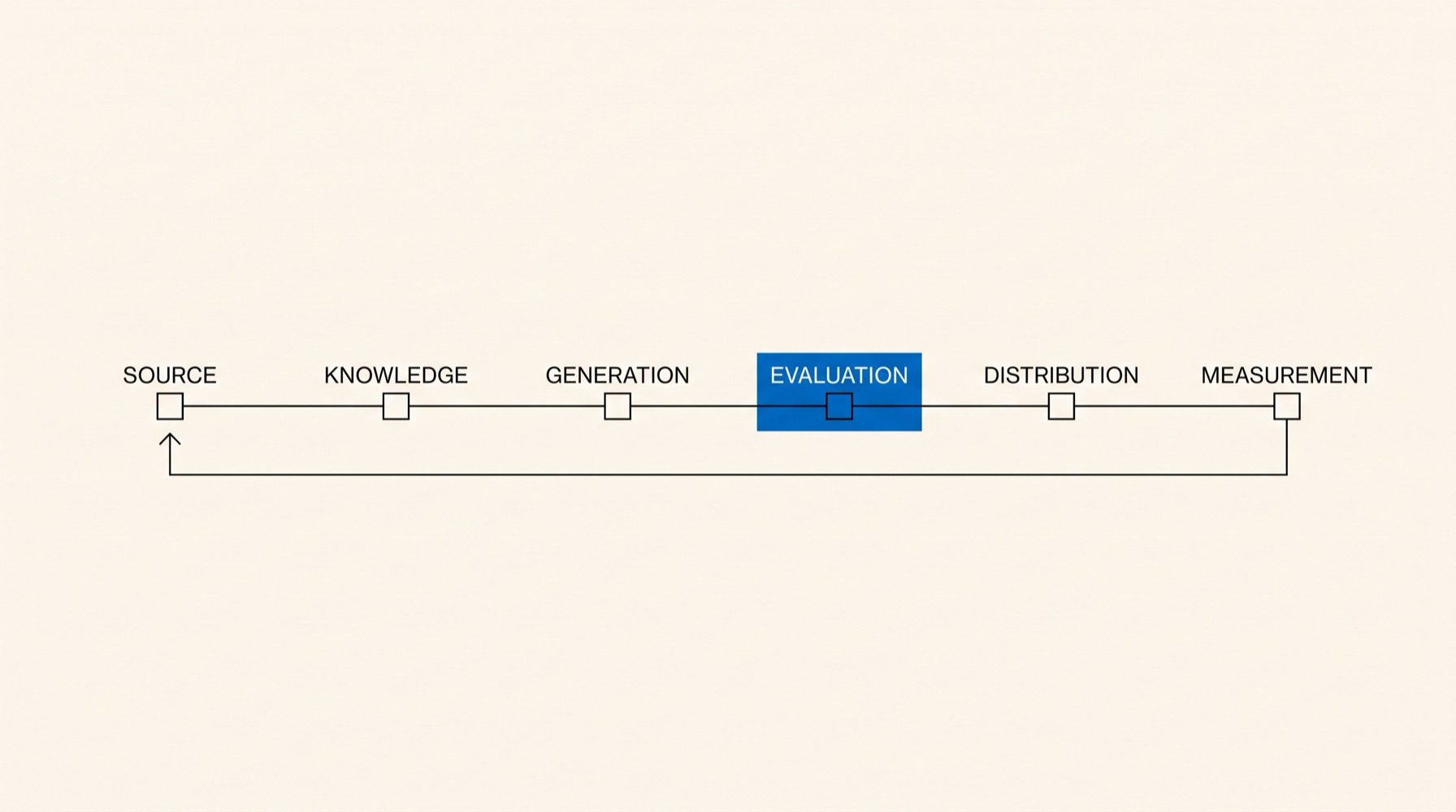
Write the input, the action, the output, and the reinvestment path. If you cannot draw it in four boxes, it is not a loop yet. Name the owner of each box.
Most dashboards measure stages: visits, leads, opportunities. Loops break at handoffs. Measure the conversion from one box to the next, and the time it takes. A loop that works in thirty days is a different asset than one that works in nine months.
Decide how often the loop turns, and what percentage of the output goes back into the input. Content that generates pipeline should fund more content. Referrals should fund the proof assets that generate more referrals. Without a rule, the output gets spent on something else.
If a loop cannot show a measurable output in two cycles, stop feeding it. Park it with a written reason, not a silent deletion. Teams keep dead loops alive because killing them feels like admitting a mistake.
Saturate the winner before you add another. The strongest loop is usually the one where a 10% improvement in conversion produces more than a 10% increase in volume. Push until the marginal return drops, then revisit the portfolio.
What I actually think
I have watched this pattern from both sides. At LinkedIn, the growth that lasted was never a clever hack. It was a loop: content created visibility, visibility created conversations, conversations produced insight about what the market cared about, and that insight became the next round of content. The loop made each cycle smarter. The hacks made good demo slides.
Building SignalScout taught me the same lesson at a smaller scale. The teams that got value from signal data were not the ones running the most reports. They were the ones that closed the loop between what they learned and what they did next. Everyone else bought a dashboard and let it go stale.

AI made experiments cheap. That did not make growth easier. It moved the bottleneck from execution to judgment. The teams that win now are not the ones with the most tests. They are the ones with a loop that turns every test into a better next test.
Here is the part I think most people get wrong about AI and growth. They assume that cheaper production means more shots on goal. It does not. It means the cost of a bad hypothesis is now almost zero, so the supply of bad hypotheses goes to infinity. The scarce resource is the loop that tells you which hypothesis mattered and routes that learning into the next cycle.
That is also why I do not believe in the “growth team” as a separate SWAT team anymore. If growth lives in a side pod, the loop never connects to the main business. The best growth operators I know sit inside the revenue motion, own a loop end to end, and are measured on whether the loop got stronger, not on how many tests they shipped.
Start with the loop you already have
You do not need a new channel, a new tool, or a new hire to run this audit. You need one page, four boxes, and the honesty to admit which loop is actually carrying the business. If you have been treating growth as a list of experiments, the audit will feel uncomfortable. That is the signal that it is working.
If you want a second set of eyes on the loop, the growth strategy work is the place to start, and the 80/20 GTM rule explains why saturating one loop beats spreading thin. The customer intelligence loop is the retention-side companion to this piece. For the buyer-side context, read the 6sense 2025 B2B Buyer Experience Report and HBR’s analysis of the value of keeping the right customers.