





TL;DR
- The problem: Marketing ops spends its budget on scoring models while the routing rule, the one line of logic that decides whether a human ever sees the lead, goes unwritten.
- Why scores fail: A score is a compiled guess about intent. A route is a decision about action. Only one of them can be audited against closed revenue.
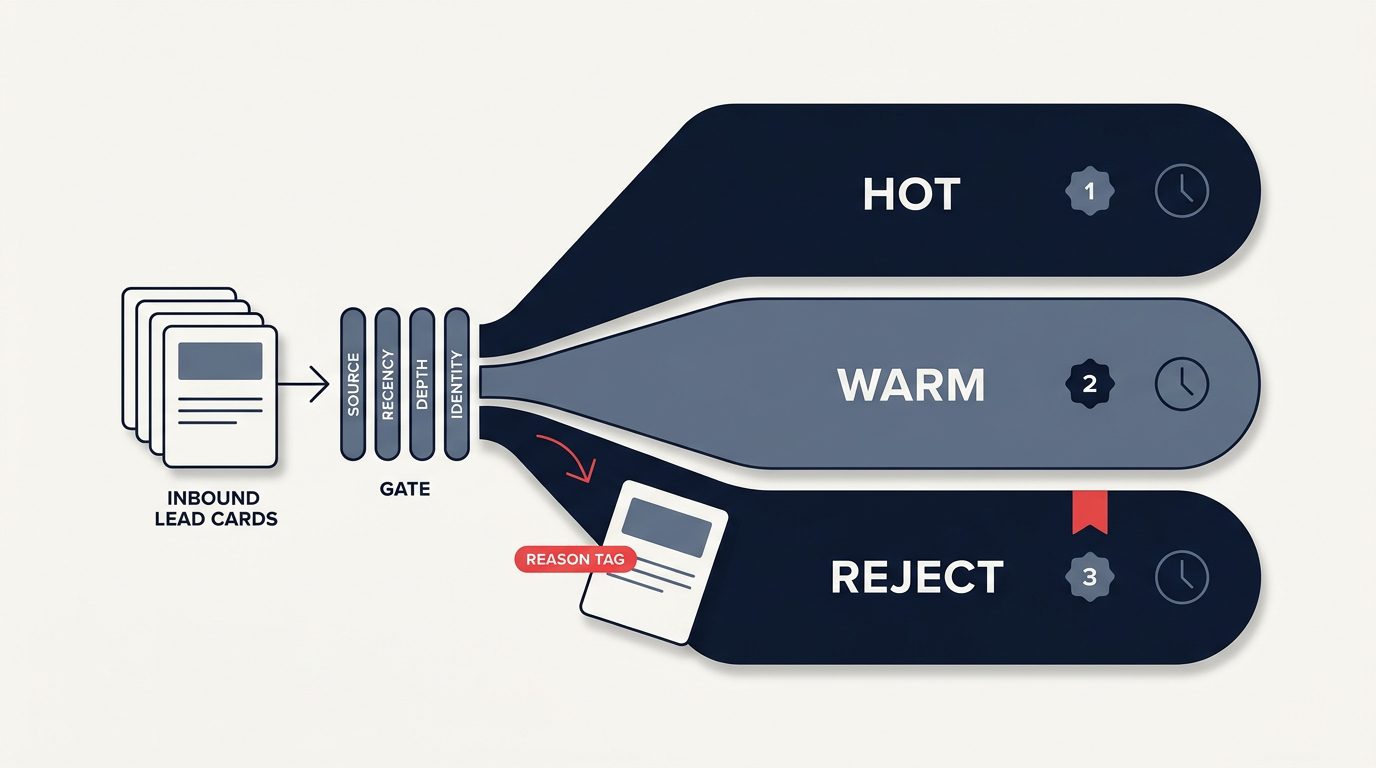
- What a route needs: Source, recency, depth, and a person-level identity. Miss identity and the whole rule silently degrades into a list of job titles.
- The audit: Ninety days of routed leads, split by lane, compared to closed-won. The gap tells you which condition is dead.
- The rule: Three lanes, one rejection lane, one owner per lane. If a lead can leave the system without a recorded reason, your ops is a queue, not a system.
The Handoff Is a Rule, Not a Meeting
Every marketing ops conversation eventually lands on the same complaint: sales does not follow up. The fix is usually a meeting, a new SLA document, and a slide that says we are aligned now. Six weeks later the same complaint returns with a different name attached.
The handoff is not a meeting. It is a rule, and it runs whether anyone is watching or not. A lead arrives, a condition evaluates, a record lands in a queue, and a timer starts. If that chain is wrong, no amount of alignment survives it. The SDR opens the record, sees a job title and a company with no context, and does what any rational person does with a low-information task: they pick the easier one next to it.
I have watched this happen in three different companies and it always looks the same from the inside. Marketing believes it delivered 400 leads. Sales believes it received 40. Both are reading the same number and describing two different systems, because the routing rule created a category nobody named: the leads that were delivered into a queue that was never going to be worked.
Ask one question of your own pipeline: can a lead reach a rep without any record of why it was routed there? If the answer is yes, you do not have routing. You have sorting.
Why the Lead Score Keeps Lying
Lead scoring is not stupid. It is just answering a different question than the one ops needs answered. A score estimates how much a person looks like a buyer. A route decides what a human should do in the next hour. Those are not the same problem, and the second one is the one that generates revenue.
The mechanics explain the drift. Most scoring models are built from historical closed-won data, which means they are trained on the leads that survived the previous routing rule. If that rule was biased toward enterprise logos, the model learns that enterprise logos are good, and the bias becomes a feature. Run this loop for two years and your score is a very accurate model of your own past routing decisions, dressed up as buyer intent.
Salesforce draws the distinction cleanly in its own documentation. Grading is explicit fit, based on firmographics and profile answers. Scoring is implicit interest, based on behavior. Teams collapse the two into one field, usually called score, and then argue about whether a lead is good without ever separating fit from interest. A CMO at a company that should never buy from you can score 92 and still be a waste of an SDR hour. A quiet manager at your best-fit account can score 8 and be the only deal in the quarter.
This is why I stopped treating the score as the output of marketing ops. The score is an input. The route is the output. See the Salesforce grading guidelines for the explicit fit side, and this Pardot grading walkthrough for how teams actually build it. Both are about fit. Neither tells you what to do at 9 a.m. on Monday.
What a Routing Rule Actually Needs
A route that survives contact with a real pipeline tests four conditions. Not three, not six. Four, in this order, because each one can invalidate the next.

Most routing rules test one and a half of these. They test source because the form already has a field for it, and they half-test recency because the CRM timestamps everything. Depth and identity are the ones that require work, so they get skipped, and the rule quietly becomes a funnel for whoever filled out the shortest form.
The 90-Minute Routing Audit
You do not need a consultant to find this. You need a spreadsheet, ninety days of history, and the willingness to look at the rejection lane, which is where the truth usually lives.
I have run this audit on my own pipeline and the result was not subtle. Of 736 people in a system I had built, 717 read as no-signal. The write step created the person and skipped the signal, so the engagement was never recorded. The routing layer above it was behaving exactly as designed, sorting people into lanes based on data that had never been recorded. You can read the full teardown in what I actually run versus what the vendor sells.
The lesson generalizes past my own stack. A routing rule is a read of your data. If the write side drops the signal, the rule reads a fiction and reports it with total confidence. That is not a sales problem or a marketing problem. It is an ops problem with a revenue symptom.

The Three Lanes
Three lanes, one owner each, one rejection lane with a written reason. That is the whole design. Anything more elaborate is usually a way to avoid deciding.
| Lane | What qualifies | Owner | Clock |
|---|---|---|---|
| Hot | Named person, fit confirmed, two or more signals inside 14 days | Rep, personal outreach | Reply within 4 business hours |
| Warm | Named person, fit confirmed, one signal or a repeat visit | Marketing, signal-based nurture | First touch within 48 hours |
| Reject | No identity, no fit, or no signal after 30 days | Ops, with a recorded reason code | Exit within 7 days |
The rejection lane is the part most teams skip, and it is the part that makes the other two work. A reject is not a failure. It is a decision with a reason attached, and that reason is what lets you improve the rule next month. Without it you get a queue that grows forever and a team that slowly stops trusting the number.
This is the same pattern I use for account selection in the ABM engine: a small number of lanes, a named owner, and a clock. The mechanism is boring on purpose. Boring is what survives a busy quarter.
What I Do Differently
I do not let marketing own the score and sales own the follow-up. That split guarantees the argument. I make one person own the rule, which means owning the conditions, the lanes, the clocks, and the reason codes. In my own operation that person is me, because at this size the rule is the marketing strategy.
I also refuse to route on a score alone. A score can put a lead in a lane, but it cannot be the only condition, because it cannot answer the identity question. If I cannot name the human and say why they would care this week, the lead is warm at best, no matter what the number says.
And I write the reason codes before I write the automation. The codes force the argument early, when it is cheap. Which reasons are legitimate? Bad fit, no identity, competitor, student, existing customer, wrong geography. Six codes is enough. If your team cannot agree on six, they will not agree on a routing rule either, and the automation will encode the disagreement instead of resolving it.
One more thing I do: I test the rule against the sales conversation, not the dashboard. Pull five calls from last month. Ask the rep why they picked up that lead. If their reason is not one of the four conditions, the rule is missing a signal, and the rep is doing the routing by hand. That manual work is the most expensive thing in your marketing ops, and it is invisible on every report. It connects directly to the signal work I wrote about here, where the point was never more data. It was the right data in the right hands.
What I Would Not Automate
The lane assignment can be automated. The clock enforcement should be automated. The rejection reason should never be automated, because the moment a machine writes the reason, the reason stops teaching you anything.
I would also leave the first touch to a person. A personalized note from a named human is the one thing a competitor cannot copy at scale, and it is the cheapest signal you will ever send. Automation earns the right to send the second touch, after a human has established why this person is worth talking to.
And I would not automate the weekly review. Thirty minutes, one page, four numbers: leads per lane, reply rate per lane, meetings per lane, and rejected-with-reason. If a lane has volume and no meetings for three weeks in a row, the lane is wrong. That is a decision, and decisions belong to people.
The Rule You Can Write Today
Write one sentence for each lane. Name the conditions, the owner, and the clock. Put the rejection reasons in a list underneath. That document is your routing rule, and it is more valuable than any scoring model you will buy this year, because it can be read, argued with, and audited.
Then run the ninety-day audit against it. You will find one of two things. Either the rule is working and the volume is genuinely too low, which is a demand problem, or the rule is leaking and the volume was never real, which is an ops problem you can fix this month. Either answer is worth more than another dashboard.
Marketing ops is judged at the handoff. A lead score is a guess about intent, and a routing rule is a decision about action. Only the second one can be audited against revenue, so that is where the work belongs: four conditions, three lanes, one rejection reason, one owner.