






TL;DR: The MQL is dead. Not dying — dead. Companies still running MQL-based scoring models are celebrating lead volume while their pipeline flatlines. In 2026, the replacement is buying group scoring: a model that scores accounts and the groups of decision-makers within them, using real-time intent signals instead of form fills. This article breaks down why MQLs failed, the four components of a buying group scoring model, and a step-by-step rebuild you can complete in two weeks. If your CRM still uses a single-contact lead score, this is your intervention.
The MQL Funeral: What Actually Happened
For fifteen years, B2B marketing operated on a simple formula: capture an email address, assign a score based on page views and content downloads, and once that score crossed some arbitrary threshold, hand the “lead” to sales. We called it Marketing Qualified Lead scoring, and for a while, it worked well enough.
It does not work anymore.
Sales teams report that fewer than 5% of MQLs convert to real opportunities. SDRs spend 70% of their time chasing contacts who downloaded a whitepaper but have zero buying intent. Marketing teams hit their lead targets while the revenue organization misses its number. The system has become a theater of activity — lots of motion, no momentum.
Three structural shifts killed the MQL.
First, buyer anonymity. B2B buyers now complete 70-80% of their evaluation before talking to a vendor. By the time someone fills out a form, they have already shortlisted options. A form fill is a trailing indicator — it tells you what already happened, not what is about to happen.
Second, the buying committee. The average B2B purchase involves 6.8 decision-makers. A single-contact MQL captures one person. It says nothing about whether their CFO, VP of Ops, and CISO are aligned. You score one email address. The actual deal needs six people to agree.
Third, signal abundance. Intent data platforms, technographic providers, job change alerts, and funding event trackers now surface real buying signals that were invisible five years ago. Companies that ignore these signals and optimize for form fills are optimizing for the weakest signal in the stack.
If your demand gen strategy is built around capturing email addresses from gated PDFs, you are not generating demand. You are generating noise that your sales team has to clean up.
What Replaced It: The Buying Group Scoring Model
The replacement is not “better lead scoring.” It is a completely different object of analysis. Instead of scoring individual contacts against behavioral thresholds, you score buying groups — the constellation of people who will be in the room when the decision gets made — against intent, engagement, and fit signals.

A buying group scoring model has four components:
1. Account-Level Intent Signals (40% of Score)
This is the leading indicator. Before anyone fills out a form, accounts that are actively researching your category leave digital exhaust: third-party intent data from providers like Bombora and 6sense, first-party website activity from multiple IPs within the same company, content consumption on topics that map to your product, and competitive research behavior. These signals tell you demand exists before a human in that account knows your company name.
“Intent data tells you who is in-market right now. Form fills tell you who had a free Tuesday afternoon.”
Tools to evaluate: 6sense, Demandbase, Bombora, or for teams under $5M ARR, a simple Google Analytics company-level IP report cross-referenced with your CRM account list costs nothing and catches 60% of what the enterprise platforms surface.
2. Buying Group Coverage (25% of Score)
The single biggest blind spot in MQL-based systems is this: you might have a champion who loves your product, but if their VP has never heard of you, the deal dies in procurement. Buying group coverage measures whether you have identified and engaged contacts across the key personas required for a deal to close.
For most B2B deals, the minimum viable buying group includes: an economic buyer (budget authority), a technical evaluator (can say yes or no on capability), a champion (internal advocate), and an end user (lives with the product daily). Score each slot: identified, engaged (opened emails, attended a webinar), or champion (actively advocating). An account with only one identified contact is a lead, not an opportunity.
3. Engagement Depth (20% of Score)
The old model counted page views. The new model counts signal density: how many people from the account are engaging, across how many channels, over what time window. A single contact who read one blog post is noise. Four contacts from the same account who attended a webinar, read a case study, and visited your pricing page in a 10-day window is a buying signal. Engagement depth measures concentration and recency, not just volume.
4. Fit & Timing (15% of Score)
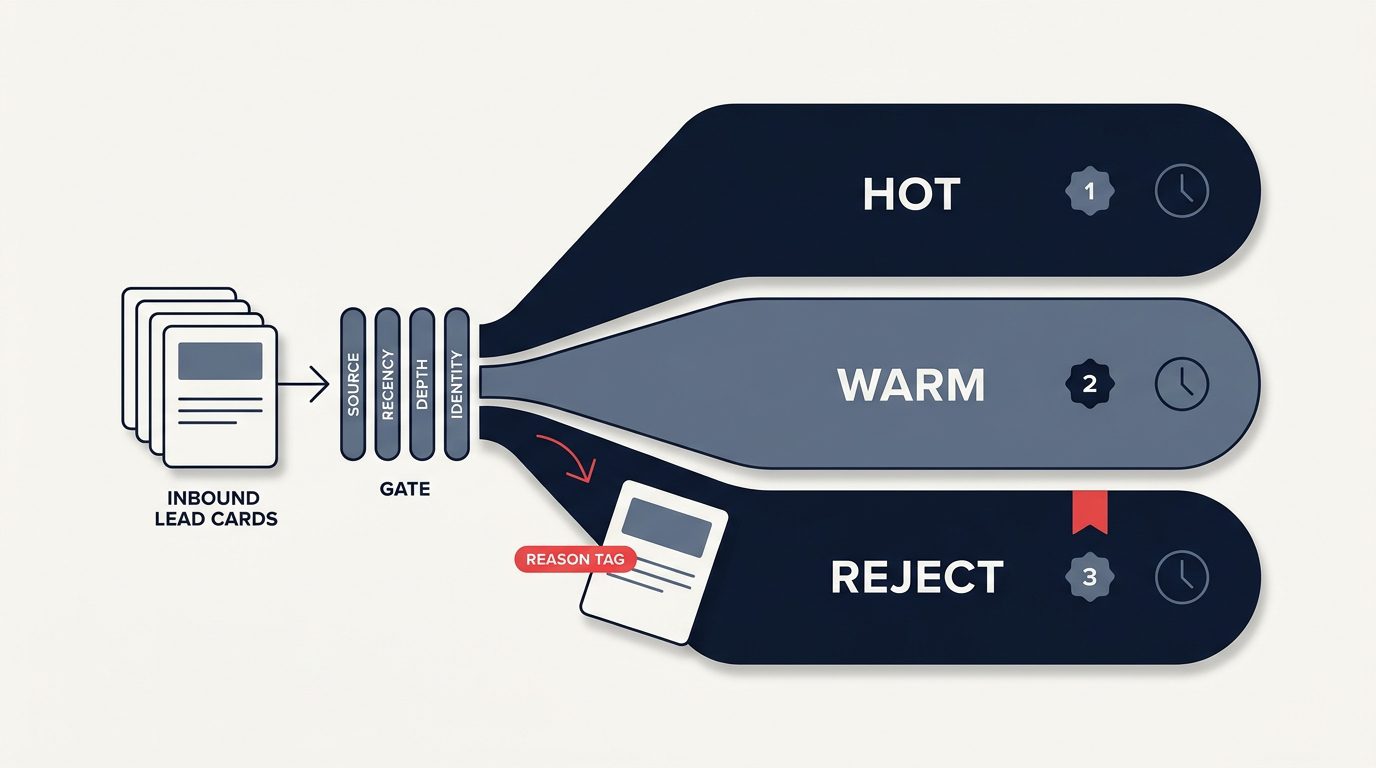
This is the familiar ICP qualification layer, but applied at the account level, not the contact level: firmographics (industry, size, revenue), technographics (tech stack compatibility), and trigger events (funding, leadership change, new initiative). In the buying group model, fit gates intent rather than the other way around. High intent with poor fit gets deprioritized. High fit with zero intent goes into nurture. High fit with active intent and strong buying group coverage goes to sales immediately.
The Two-Week Rebuild: From MQLs to Buying Groups
You do not need a six-month consulting engagement to make this shift. Here is the step-by-step rebuild:
The Metric Shift: What to Measure Instead
When you kill MQLs, you kill the dashboard most marketing teams built their reporting on. Here is what replaces it:
The three metrics that matter in a buying group model are:
Intent-Active Accounts: How many ICP-fit accounts showed intent signals in the last 30 days? This is your top-of-funnel metric. It measures demand creation.
Buying Group Coverage: Of your intent-active accounts, what percentage have identified contacts across all required roles? This is your mid-funnel metric. It measures demand capture.
Pipeline Velocity: Of accounts with >50% coverage and active intent, how fast do they move to opportunity and close? This is your bottom-of-funnel metric. It measures conversion efficiency.
Notice what is missing: form fills, page views, email opens, content downloads. Those are activity metrics, not revenue metrics. They help you diagnose but they should never be your primary score.
The Hard Part Nobody Talks About
The technical shift from MQL to buying group scoring is straightforward. The organizational shift is brutal.
Marketing teams have built careers on MQL reporting. Sales teams have built compensation plans on lead response time. Your CRM is probably configured around lead objects, not account objects. Your marketing automation sends emails to contacts, not buying groups. Every part of your stack assumes the MQL is the unit of value.
Expect resistance from three places:
Marketing leadership: “Our board report requires MQL numbers. What do we tell them?” Tell them MQLs are a lagging indicator and you are moving to a model that predicts revenue, not activity.
Sales leadership: “We need leads. You are cutting our lead flow.” No, you are replacing volume with signal. The first month feels worse. The third month pipeline is larger and closes faster.
RevOps: “The CRM is not built for this.” True. It is not. But a combination of account-level custom objects (Salesforce) or custom company records (HubSpot) with a spreadsheet-based buying group tracker will get you 80% of the way. Do not let the perfect system block the functional one.
The companies winning in 2026 did not wait for their CRM vendor to ship a buying group object. They built it in a spreadsheet, proved it worked, and then demanded their tools catch up.
Where AI Agents Fit Into This
Buying group scoring is an ideal use case for AI agents. The data sources are distributed — intent platforms, CRM contacts, website analytics, LinkedIn Sales Navigator — and the work of stitching them together into a coherent account view is exactly the kind of repetitive, multi-source synthesis that agents handle better than humans.
A well-configured AI agent can: pull intent signals (as we detailed in our AI agents deployment playbook) from your data provider daily, match them to accounts in your CRM, check buying group coverage against your defined personas, calculate a composite score, and surface the top 10 accounts for SDR outreach every morning. This is not science fiction. Teams are doing it today with tools like Clay and custom GPT workflows. The agent does not replace the strategy — it executes the scoring model you designed.
The Bottom Line
MQL scoring died because it optimized for the wrong thing: the individual, the form fill, the behavioral micro-signal. The buying group model optimizes for what actually closes revenue: account-level intent, multi-stakeholder coverage, and engagement density across a defined group of decision-makers.
The rebuild takes two weeks. The hardest part is not the technology. It is admitting that the dashboard you have been staring at for ten years was measuring activity, not pipeline.
Start Monday.
Ready to Rebuild Your Pipeline Scoring?
SignalScout helps B2B teams track intent signals, monitor buying group coverage, and surface the accounts that are ready to buy — before your competitors know they exist. See how it works.



Leave a Reply